Taoist Atlas · Volume I
The 24 Solar Terms
Long before mechanical clocks, observers along China's Yellow River measured noon shadows and divided the Earth's yearly path around the sun into twenty-four quiet thresholds of light, weather, and living Chi.
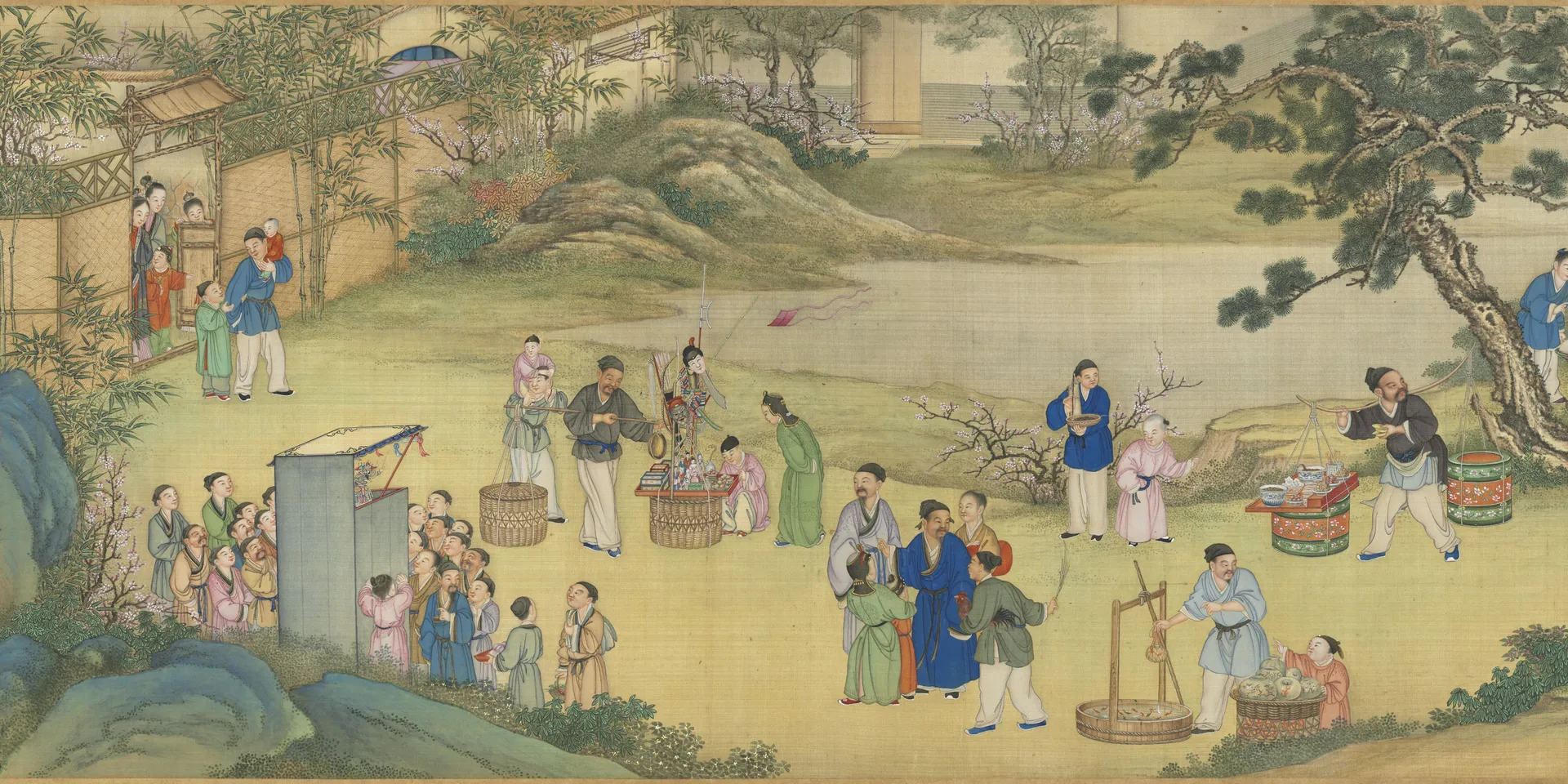
Plate IDing Guanpeng, New Year's Market in a Time of Peace, 1742, National Palace Museum, Taipei. Court painter Ding Guanpeng pictures a bustling village street market welcoming spring around the turn of the year.
01 · The Solar Year
What the 24 solar terms are
At a Glance
- 01Solar, not lunar
Each term marks an exact 15° arc of the sun's ecliptic path, landing within a day or two of the same Western date every year.
- 02Twelve openers, twelve midpoints
Twelve month-opening thresholds (节) turn the classical calendar, while twelve mid-month marks (中气) measure seasonal depth.
- 03Start of Spring opens the year
Four Pillars and Qi Men Dun Jia turn at Start of Spring around February 4 rather than January 1 or Lunar New Year.
Every year, as the Earth travels its full 360-degree orbit, the sun appears to move steadily along the sky's ecliptic path. Early Chinese astronomers divided that circle into twenty-four equal segments of fifteen degrees each, naming each fifteen-degree crossing a solar term.
Because the system follows the sun's apparent position in the sky, it belongs wholly to the solar calendar and operates independently of the phases of the moon. Year after year, each solar term lands within a day or two of the same date on the Western calendar, arriving at one shared astronomical instant around the globe.
Because clocks in North and South America run behind Beijing, that exact moment often falls a calendar day earlier in the Americas than on Chinese almanac tables.
Across the full ring of the year, the twenty-four terms alternate between twelve month-opening nodes (节) and twelve mid-month midpoints (中气). In the classical solar calendar, the year opens at Start of Spring when the sun reaches 315 degrees in early February, and it closes at Major Cold at 300 degrees in late January.
Each solar term spans roughly fifteen days and divides further into three five-day intervals called pentads. Together, those seventy-two pentads read like a field notebook of shifting winds, thawing ice, migrating birds, and ripening grain.
This way of keeping time grew out of the Yellow River basin and records the climate of China's ancient Central Plains. Its earliest complete list of twenty-four names survives in Masters of Huainan, a Western Han court compendium completed around 139 BCE.
Over the centuries that followed, traditional Chinese almanacs paired these fixed solar markers with lunar months. Folk festivals such as Lunar New Year, Dragon Boat, Mid-Autumn, and Double Ninth follow the moon, so their dates drift back and forth near neighboring solar terms from year to year.
Only two solar terms, Clear and Bright (known in English as Qingming) and Winter Solstice (known as Dongzhi), are major traditional festivals in their own right.
In 2016, UNESCO inscribed The Twenty-Four Solar Terms, knowledge in China of time and practices developed through observation of the sun's annual motion on the Representative List of the Intangible Cultural Heritage of Humanity, honoring a calendar that begins with Start of Spring and guides daily life across generations.
Outside northern China, and especially across the Southern Hemisphere where winter and summer trade places, local trees and birds keep their own timetable. What travels intact across every latitude is the habit of stepping outdoors, reading the real air on your skin, and moving in rhythm with the season beneath your feet.
Ecliptic Almanac Instrument 周天浑象
Turn the solar wheel
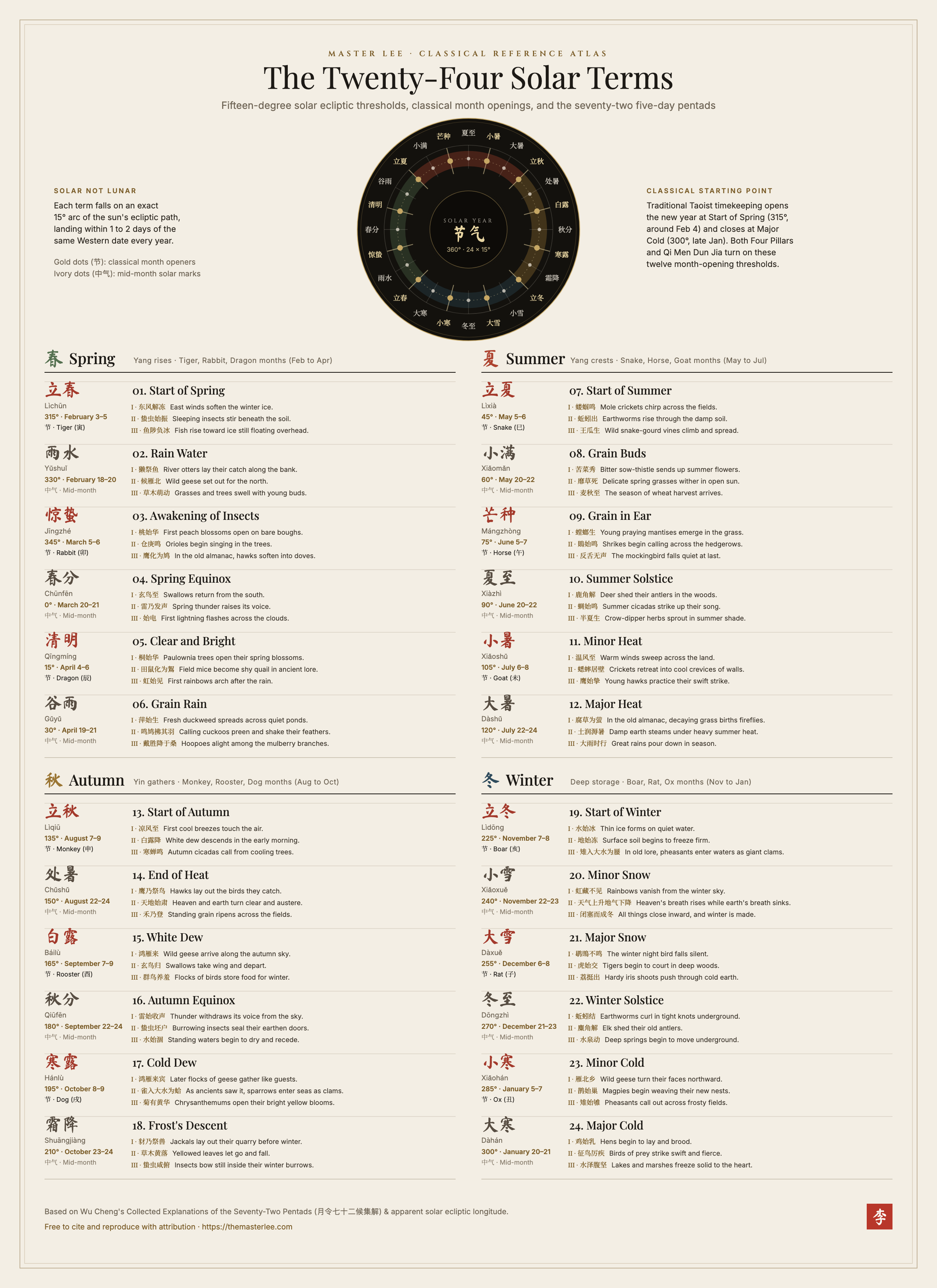
Read the wheel clockwise from Start of Spring at 315 degrees, where the classical year opens, through all four seasons to Major Cold at 300 degrees. Each spoke marks a fifteen-degree step along the sun's path. Larger dots show the twelve month-opening nodes (节), alternating with smaller dots for the twelve mid-month terms (中气). Select any solar term on the ring to jump straight to its full entry below.
Live almanac clock
Season I · Spring
Spring
In ancient Taoism, spring begins weeks before a single blossom shows on the branch. When Start of Spring arrives in early February, snow often still rests on northern rooftops while river water quietly loosens beneath the ice. What the ancients listened for was this upward stirring underground.
Dormant Yang Chi, stored deep in the earth since winter, begins rising through dark soil as cold Yin slowly relaxes its hold.
Across these six solar terms, frozen ground softens under gentle rain, early thunder wakes burrowing creatures, daylight meets night on equal footing at the equinox, and washed April skies give way to warm showers that feed young grain. Classical observers read spring as a lesson in patience with fragile beginnings. Everything that grows tall in summer starts here in damp earth, morning wind, and unhurried care, long before branches are asked to carry weight.
From Activities of the Twelve Lunar Months 清院本十二月令圖
Qing court painters, c. 1736 to 1737 · National Palace Museum, Taipei
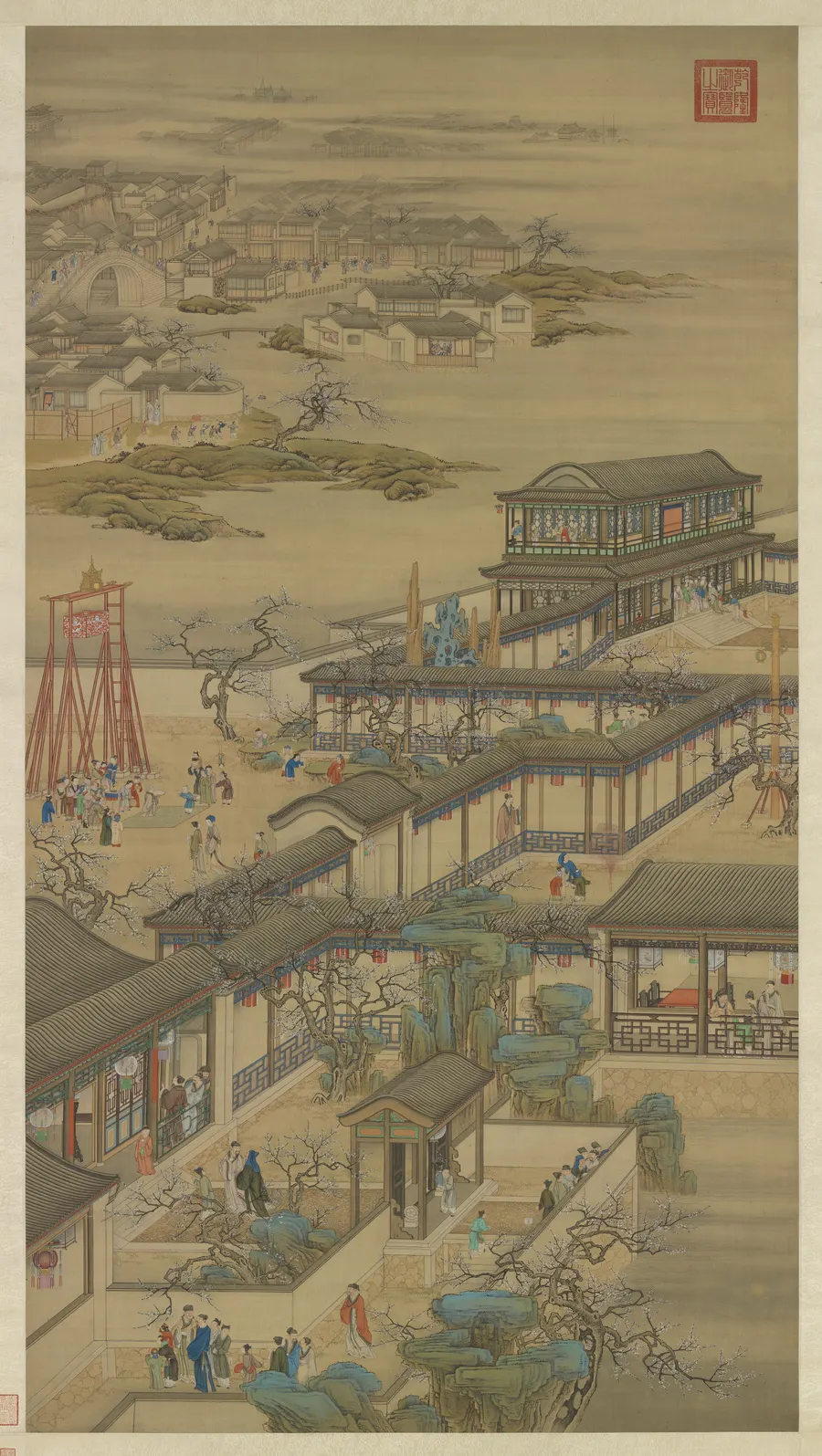
Palace gardens glow with lanterns for the first lunar month, the moon cycle in which Start of Spring or Rain Water often arrives.
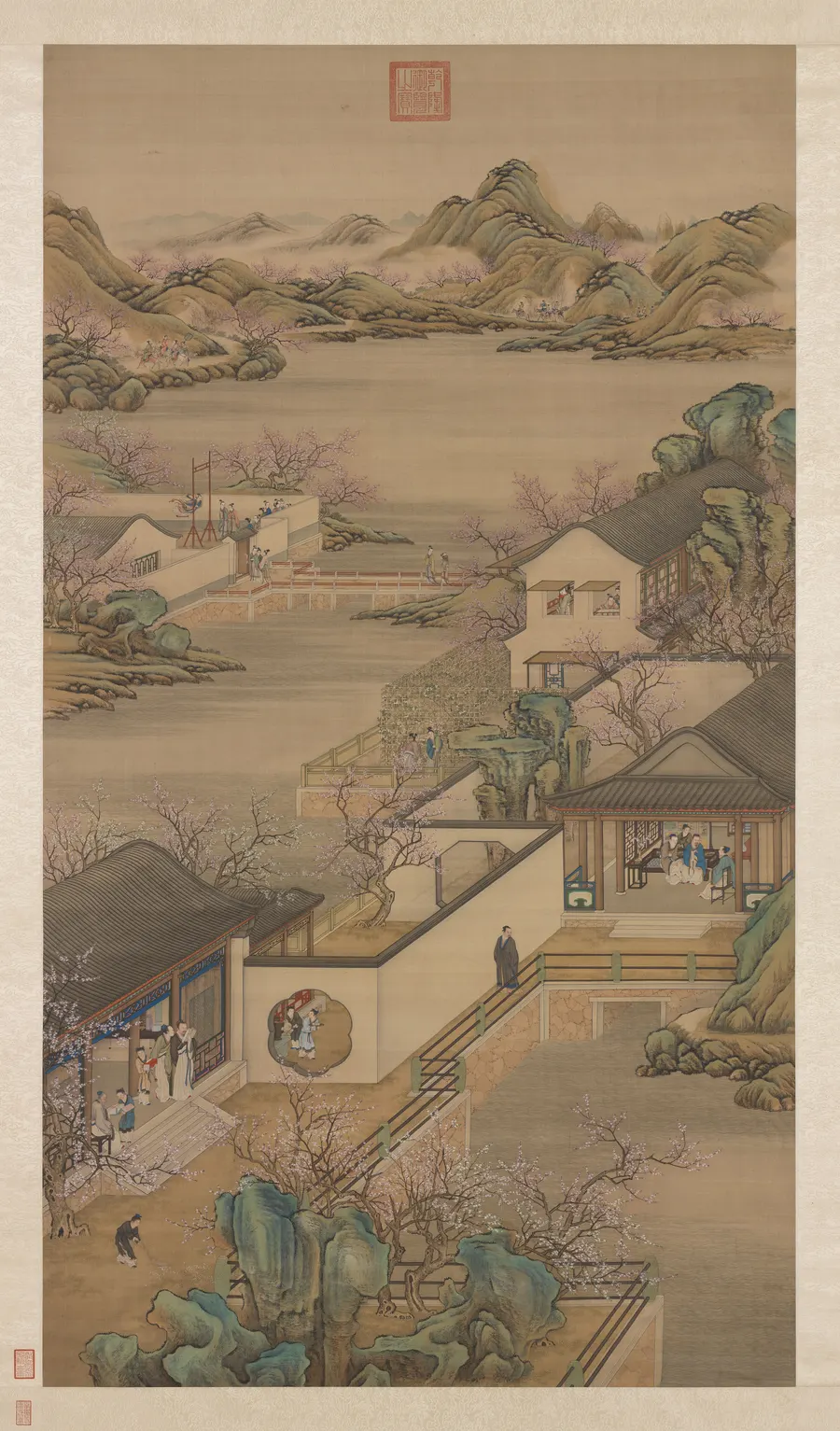
Apricot blossoms open above courtyard swings and spring games in the second lunar month, when Spring Equinox usually falls.
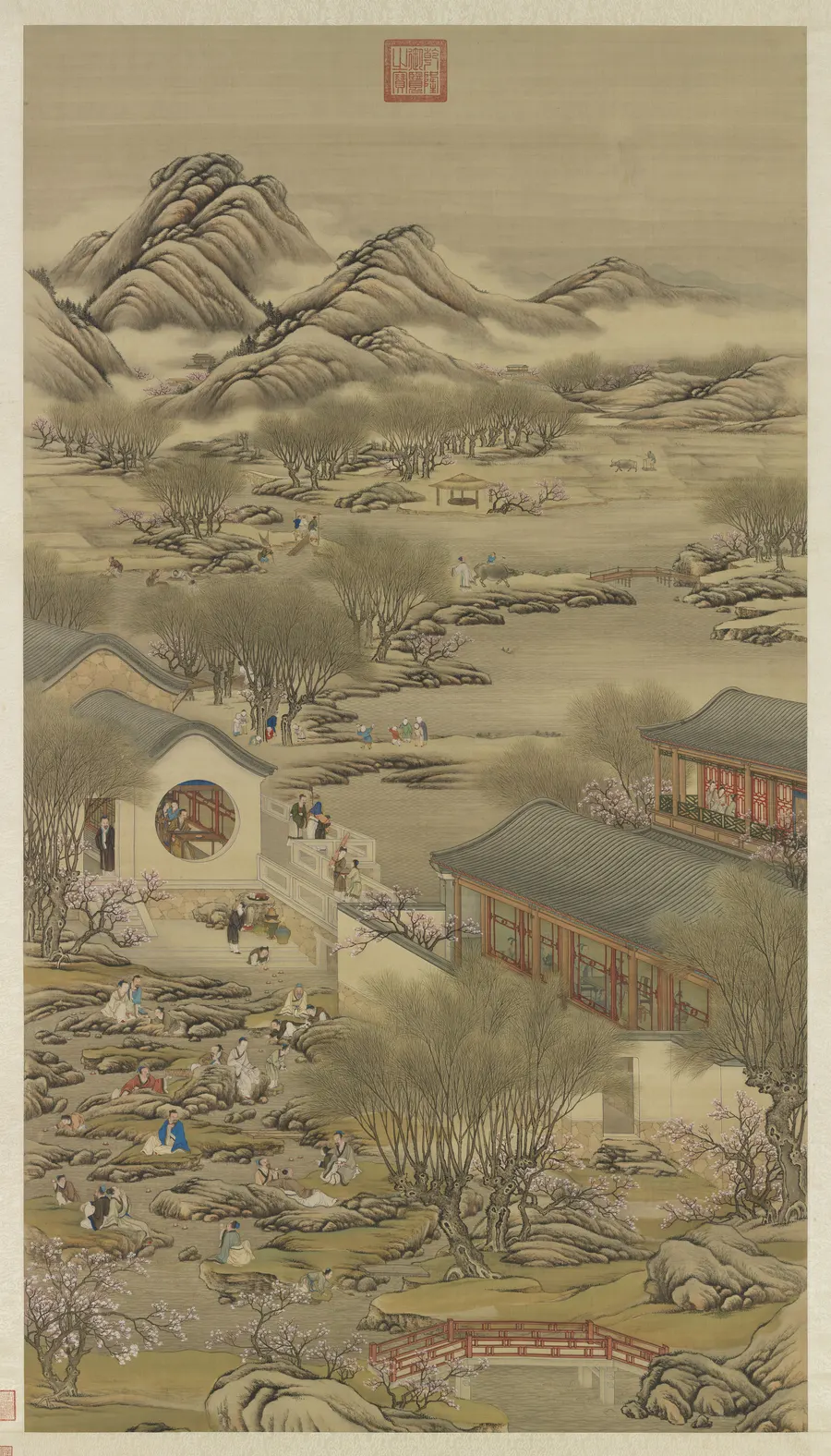
Scholars drink wine and compose verse beside winding water in peach-blossom season during the third lunar month, when Clear and Bright usually falls.
-
01 · Opens the Tiger month
Start of Spring 立春
Start of Spring opens both the classical year and the Tiger month while winter coats are still buttoned to the chin. Along the Yellow River, air remains brisk and ponds still carry ice, though the wind shifts subtly toward the east and soil softens an inch below the frost line.
Classical observers placed the new year here because renewal begins out of sight, inside dark roots and warming currents, weeks before green leaves announce it to the eye.
Ancient officials held ceremonies striking a clay spring ox to welcome the farming year, while northern households traditionally "bite the spring" over thin pancakes and crisp raw radish.
- 东风解冻East winds soften the winter ice.
- 蛰虫始振Sleeping insects stir beneath the soil.
- 鱼陟负冰Fish rise toward ice still floating overhead.
Practice: Clear one corner of your desk or kitchen counter today and set a single cut branch or green stem in clean water where morning light reaches it.
-
02 · Mid-month term
Rain Water 雨水
Fifteen days into spring, rising warmth meets cool sky and winter snow turns into light, steady rain. Across central China, riverbanks thaw enough for otters to hunt again, wild geese trace long lines northward, and tight buds swell along willow and fruit branches.
Moisture sinks into plowed ground without the force of summer storms. In household life as in farming, this midpoint of the Tiger month rewards patient preparation before visible growth accelerates in March.
Farming households traditionally inspect seed stores, mend tools, and ready ditches and soil while early spring rain softens the ground.
- 獭祭鱼River otters lay their catch along the bank.
- 候雁北Wild geese set out for the north.
- 草木萌动Grasses and trees swell with young buds.
Practice: Write down one commitment that needs quiet, steady care this month and block an unhurried hour for it on your calendar.
-
03 · Opens the Rabbit month
Awakening of Insects 惊蛰
Warm moist air from the south meets lingering northern chill, and the first low thunderclaps roll across the valleys. In classical observation, that sound shakes awake beetles, frogs, and worms that spent winter sealed underground.
Peach boughs blush into blossom and orioles call from the treetops as Awakening of Insects opens the Rabbit month in the classical calendar. Winter stillness gives way to open motion, and plans kept indoors step out under the sky.
Hearing the first spring thunder, farming villages across China traditionally lead plows into the fields to begin spring tilling in earnest.
- 桃始华First peach blossoms open on bare boughs.
- 仓庚鸣Orioles begin singing in the trees.
- 鹰化为鸠In the old almanac, hawks soften into doves.
Practice: Step outside for a brisk twenty-minute walk without headphones today and let winter stiffness loosen from your shoulders.
-
04 · Mid-month term
Spring Equinox 春分
When the sun crosses zero degrees along the ecliptic, daylight and darkness divide the twenty-four hours evenly from pole to pole. Where Western calendars treat this day as spring's beginning, classical Chinese timekeeping recognizes it as spring's balanced midpoint, halfway between early February's thaw and early May's summer warmth.
Swallows return to nest beneath courtyard eaves while thunder and distant lightning gather across warming skies. Even the household schedule feels lighter when effort and rest share equal ground.
Celebrating the even poise of day and night, families and children traditionally gather around tables to stand fresh eggs upright on end.
- 玄鸟至Swallows return from the south.
- 雷乃发声Spring thunder raises its voice.
- 始电First lightning flashes across the clouds.
Practice: Look at your week on paper tonight and trim one evening obligation so rest and work stand on more even ground.
-
05 · Opens the Dragon month
Clear and Bright 清明
Clear and Bright opens the Dragon month in the classical calendar just as northern dust settles and spring showers leave air crisp and luminous. Paulownia blossoms open high overhead, rainbows arch across washed hillsides, and every path turns green.
Alone with Winter Solstice among the twenty-four terms, Clear and Bright is also a beloved festival in its own right. Families remember their ancestors and walk beneath budding trees on the same afternoon, where memory and fresh life share one breath.
Families traditionally sweep ancestral graves, walk through green countryside, fly kites in open wind, and in southern river towns share sweet green rice dumplings.
- 桐始华Paulownia trees open their spring blossoms.
- 田鼠化为鴽Field mice become shy quail in ancient lore.
- 虹始见First rainbows arch after the rain.
Practice: Wipe one windowpane until the glass shines clean, then call an elder or write down one family story worth keeping.
-
06 · Mid-month term
Grain Rain 谷雨
Closing the six turns of spring, Grain Rain brings broader, warmer downpours that soak newly sown millet, rice, and wheat across the plains. Duckweed carpets calm pond water while hoopoes flash their striped crests among mulberry leaves where silkworms feed.
Cold snaps grow rare now, and spring's patient groundwork hands the fields directly to summer warmth. What began as a hidden stir beneath February ice now stands rooted in open daylight, ready for the long climb ahead.
Tea growers traditionally pick tender spring leaves prized as Grain Rain tea, while families gather to admire blooming peonies, long called the flower of Grain Rain.
- 萍始生Fresh duckweed spreads across quiet ponds.
- 鸣鸠拂其羽Calling cuckoos preen and shake their feathers.
- 戴胜降于桑Hoopoes alight among the mulberry branches.
Practice: Steep a cup of loose-leaf green or spring tea today and drink it warm beside a window before opening your messages.
Season II · Summer
45° to 120° · Snake, Horse & Goat Months
Summer
Summer in the classical almanac is the season of thick green canopy, rising sap, and full outward reach. From early May through late July, Yang Chi climbs steadily across long bright days. Vines scale garden trellises overnight, wheat kernels swell inside green husks, and evening ponds fill with the chorus of frogs, crickets, and cicadas.
Right at the noon summit of that brightness sits a quiet Taoist observation. On Summer Solstice, the longest day in the northern sky, outward Yang reaches its limit and the first cool thread of Yin stirs unseen beneath the warm earth.
Ancient households met these six solar terms by pairing early diligence with afternoon shade. Farmers worked the fields at daybreak while air was merciful, then stepped back into waterside pavilions and cool stone courtyards during blazing midday hours so human strength stayed whole all summer long.
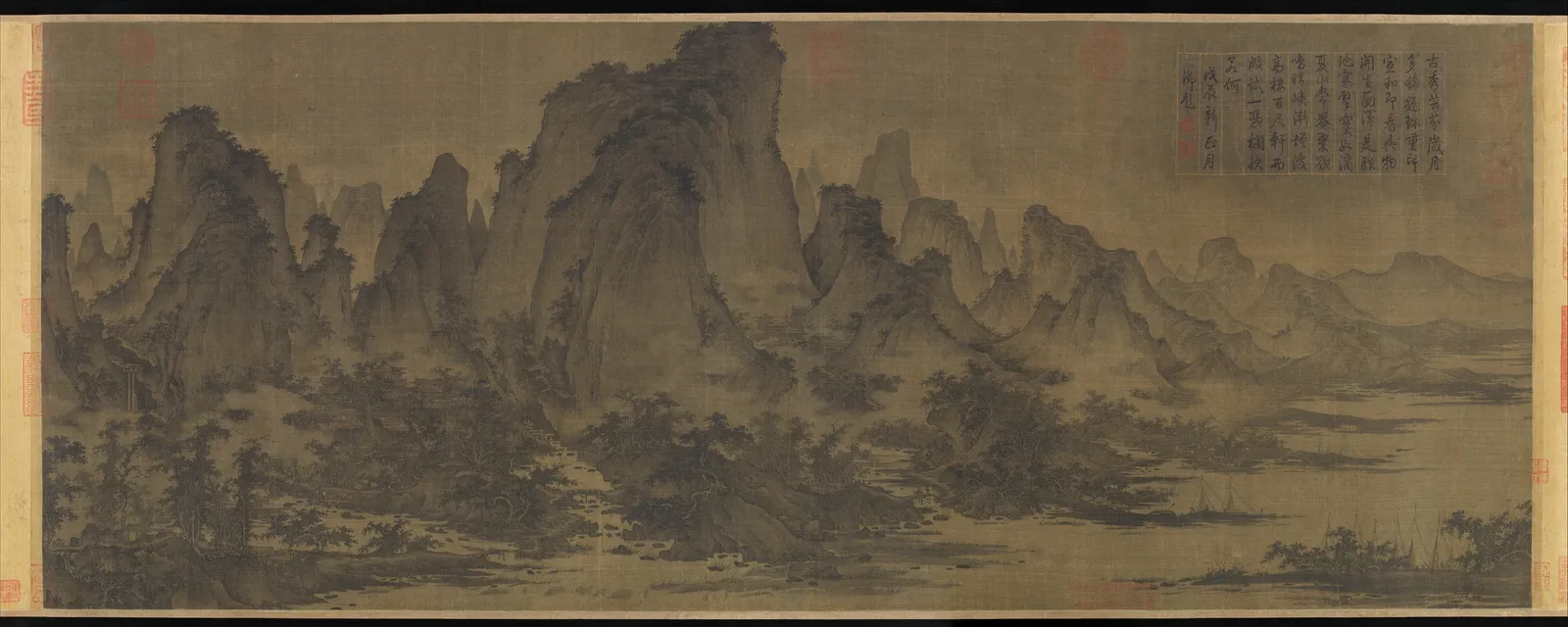
Northern Song Handscroll · 北宋手卷
From Activities of the Twelve Lunar Months 清院本十二月令圖
Qing court painters, c. 1736 to 1737 · National Palace Museum, Taipei
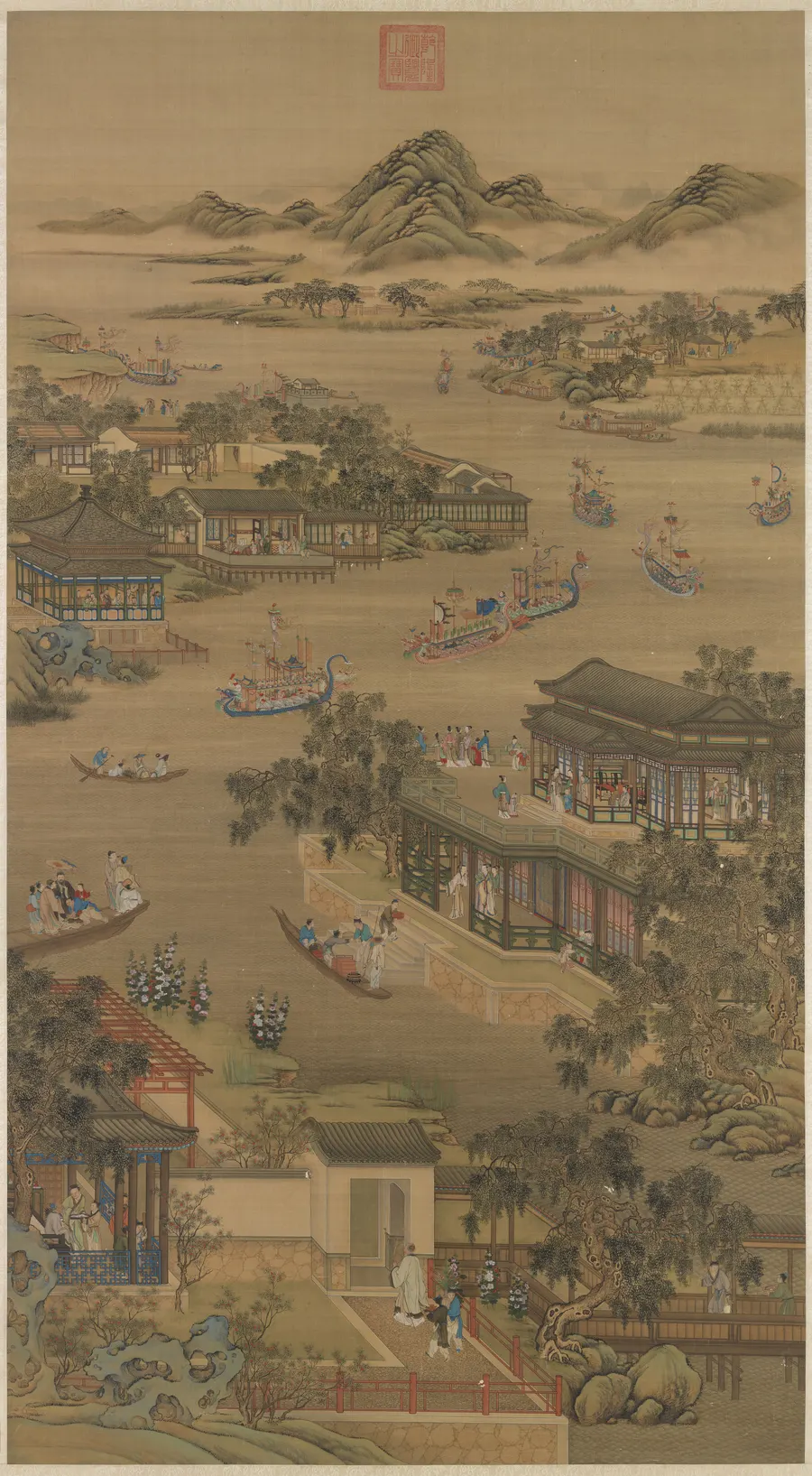
Dragon boats race across water for the fifth-month festival, a lunar celebration that usually lands near Grain in Ear or Summer Solstice.
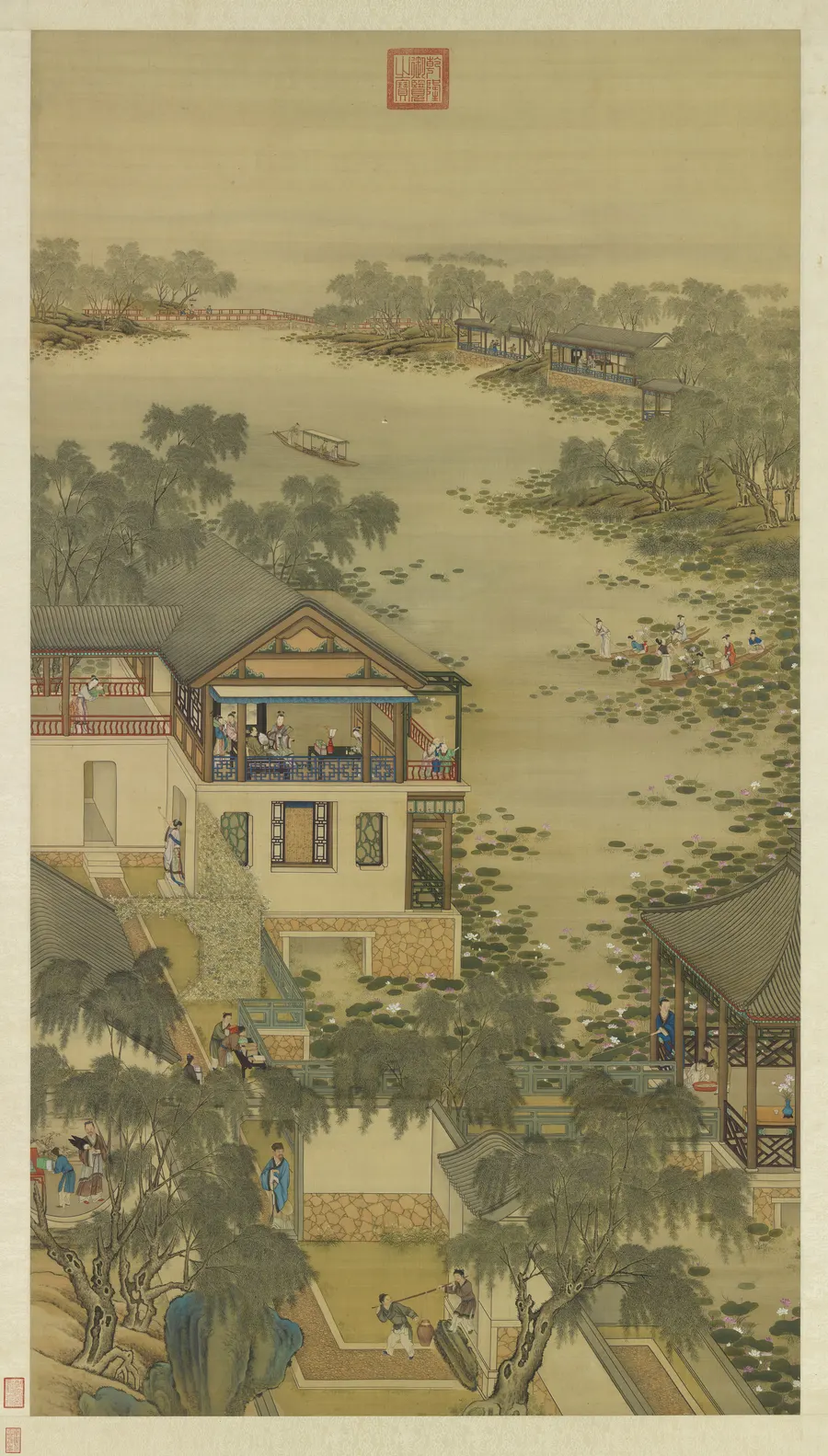
Waterside pavilions, lotus gathering, and airing books in summer sun mark the sixth lunar month, often overlapping Minor Heat and Major Heat.
-
07 · Opens the Snake month
Start of Summer 立夏
Start of Summer opens the Snake month in the classical calendar when spring petals have mostly fallen and orchard boughs thicken into deep green foliage. Evenings turn mild enough for mole crickets to sing along field ridges, earthworms loosen warm garden beds, and climbing vines lengthen almost visibly between morning and dusk.
Early May brings gentle, expansive momentum before July's fierce heat arrives, and young crops established in spring shift from taking root to filling out tall stems and leaves.
Towns and villages traditionally bring out tall balance scales to weigh elders and children at the seasonal turn and share boiled Start of Summer eggs.
- 蝼蝈鸣Mole crickets chirp across the fields.
- 蚯蚓出Earthworms rise through the damp soil.
- 王瓜生Wild snake-gourd vines climb and spread.
Practice: Swap heavy winter throws on your sofa or bed for breathable cotton or linen today so your rooms welcome warmer air.
-
08 · Mid-month term
Grain Buds 小满
Look closely at the calendar names and a quiet detail stands out. Minor Cold leads to Major Cold, Minor Snow to Major Snow, Minor Heat to Major Heat, while Grain Buds has no "Major Fullness" after it.
Across northern fields, winter wheat kernels swell with milky grain inside green husks without reaching final ripeness, while tender spring grasses bow out under brighter sun. Classical thinkers cherished this seven-tenths state, seeing sustainable promise in a vessel that stops short of spilling over.
Traditional wisdom notes the absence of a "Major Fullness" term after Grain Buds, prizing wheat kernels that plump steadily without tipping into excess.
- 苦菜秀Bitter sow-thistle sends up summer flowers.
- 靡草死Delicate spring grasses wither in open sun.
- 麦秋至The season of wheat harvest arrives.
Practice: Leave one small margin unscheduled in your day so your calendar keeps room to breathe between morning and bedtime.
-
09 · Opens the Horse month
Grain in Ear 芒种
Grain in Ear opens the Horse month at the busiest crossroads of the agricultural year. Its two Chinese characters pair two urgent tasks in one breath, reaping bearded winter grains like wheat and barley before summer storms flatten them while setting young rice seedlings into flooded paddies under warm rain.
Mantises emerge in thick grass and spring songbirds quiet down as orchards trade blossoms for swelling fruit. Endings and new plantings share the exact same week in the fields.
Alongside urgent harvesting and rice planting, old courtyards once held farewell gatherings for the flower spirits as petals faded, a custom pictured in chapter twenty-seven of Dream of the Red Chamber.
- 螳螂生Young praying mantises emerge in the grass.
- 鵙始鸣Shrikes begin calling across the hedgerows.
- 反舌无声The mockingbird falls quiet at last.
Practice: Wrap up one finished spring project cleanly today before giving your attention to what summer asks of you next.
-
10 · Mid-month term
Summer Solstice 夏至
At ninety degrees of solar longitude, the sun climbs to its highest noon arc over the Northern Hemisphere and stretches daylight to its longest span of the year. Cicadas strike up their steady chorus in tall elms while stags shed winter-grown antlers in the woods.
Blazing summer heat continues building through July as the earth releases stored warmth, even as the sun's daily path begins edging southward and wakes the first quiet thread of Yin underground.
Following the old northern saying "dumplings at Winter Solstice, noodles at Summer Solstice," families traditionally celebrate the longest day of the year over bowls of fresh wheat noodles.
- 鹿角解Deer shed their antlers in the woods.
- 蜩始鸣Summer cicadas strike up their song.
- 半夏生Crow-dipper herbs sprout in summer shade.
Practice: Pause around midday to notice how far sunlight reaches into your room, then sit quietly in cool shade for ten unhurried breaths.
-
11 · Opens the Goat month
Minor Heat 小暑
Minor Heat opens the Goat month when afternoon air grows thick and even passing breezes carry warmth off the fields. Crickets leave sun-baked soil for the cool stone crevices of courtyard walls, and young hawks test their wings high in rising air currents.
Across China, this solar term begins the early stretch of high summer's hottest days. Traditional households work gently with the heat, opening sunlit courtyards to air stored garments and scrolls while keeping afternoon schedules unhurried.
Entering the season's three stretches of peak summer heat, households traditionally brew seasonal summer tea and spread books, scrolls, and clothing out in bright sunlight to air away dampness.
- 温风至Warm winds sweep across the land.
- 蟋蟀居壁Crickets retreat into cool crevices of walls.
- 鹰始挚Young hawks practice their swift strike.
Practice: Pull a few stored winter coats or closely shelved books into fresh air today so closets stay dry through high summer.
-
12 · Mid-month term
Major Heat 大暑
Closing summer's six solar terms, Major Heat brings the year's highest temperatures together with heavy monsoon moisture. Afternoon thunderheads build fast and pour warm sheets of rain onto thriving rice paddies, precisely when summer crops grow fastest in heat and water combined.
Once dusk settles over damp meadows, fireflies drift upward like floating sparks. Having climbed as high as summer can reach, the season prepares right at its peak to hand the sky to early August's first cool breeze.
Through the deepest days of high summer heat, townsfolk traditionally set out pots of seasonal tea in shady doorways and air stored books and winter textiles under clear sun.
- 腐草为萤In the old almanac, decaying grass births fireflies.
- 土润溽暑Damp earth steams under heavy summer heat.
- 大雨时行Great rains pour down in season.
Practice: Run cool water over your wrists in the late afternoon and let non-urgent errands wait until evening softens the street.
Your Own Solar Clock
See when the next solar term arrives where you live
Convert all twenty-four solar thresholds into your exact local time zone, or receive Master Lee's short note each time a new solar month opens.
Letters from Master Lee
Receive Master Lee's quiet notes when each solar month turns, plus early previews of Your Month Ahead.
Season III · Autumn
135° to 210° · Monkey, Rooster & Dog Months
Autumn
Autumn arrives in the classical calendar while afternoon pavements still hold August heat. What changes first is the feel of the wind after sundown and the height of the clouds overhead.
Across these six solar terms, expansive summer Yang draws slowly inward from leaf tips toward trunks and deep roots, while cooling Yin condenses night moisture first into silver dew on courtyard grass and later into crisp white frost on rooftops.
Heavy summer dampness thins away until distant mountain ridges stand sharp against clear sky. For farming villages along the Yellow River, these weeks meant reaping ripened millet and rice and bringing every basket safely under roof before cold winds stripped the trees. In ancient Taoism, autumn invites this same clear-eyed steadiness in daily life, gathering what the year has grown, storing what winter will need, and letting spent leaves drop cleanly back to the ground.
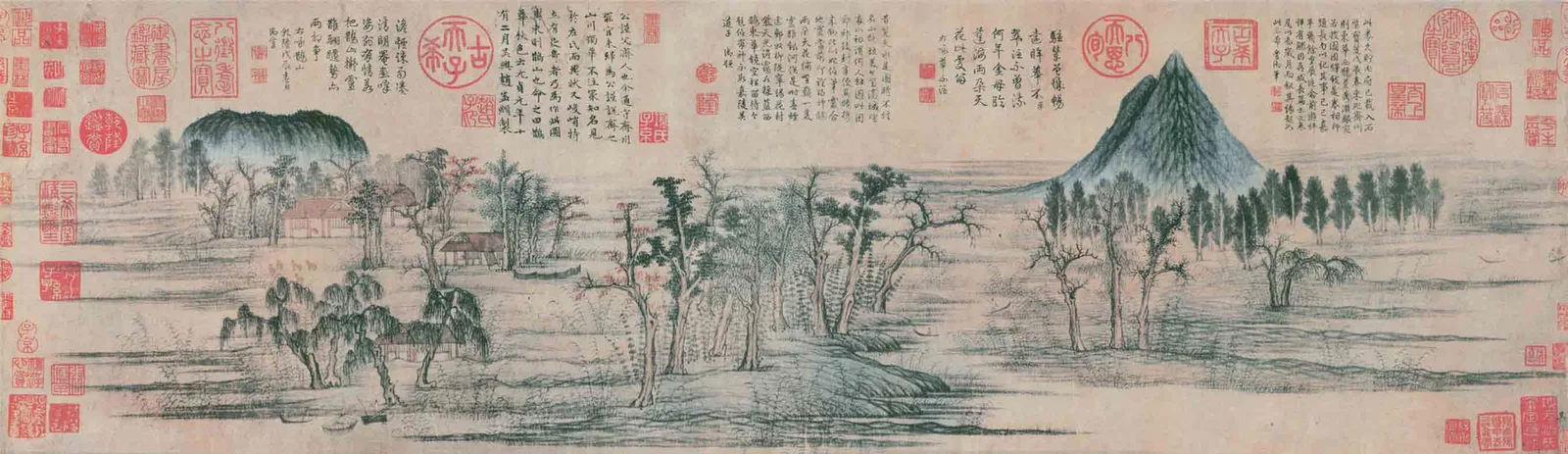
Yuan Dynasty Handscroll · 元代手卷
From Activities of the Twelve Lunar Months 清院本十二月令圖
Qing court painters, c. 1736 to 1737 · National Palace Museum, Taipei
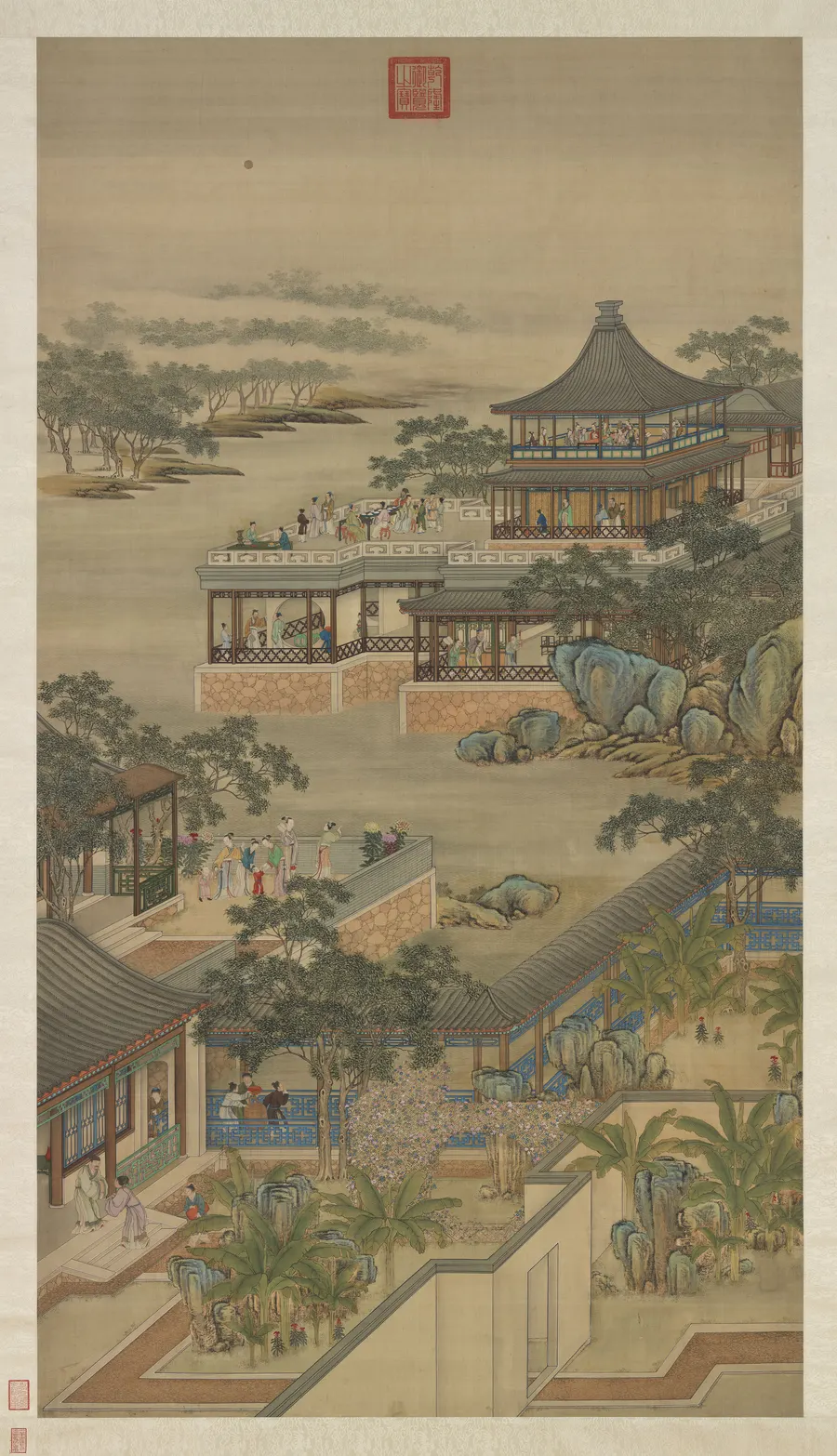
Court figures gather to admire the Mid-Autumn moon in the eighth lunar month, which usually falls near Autumn Equinox.
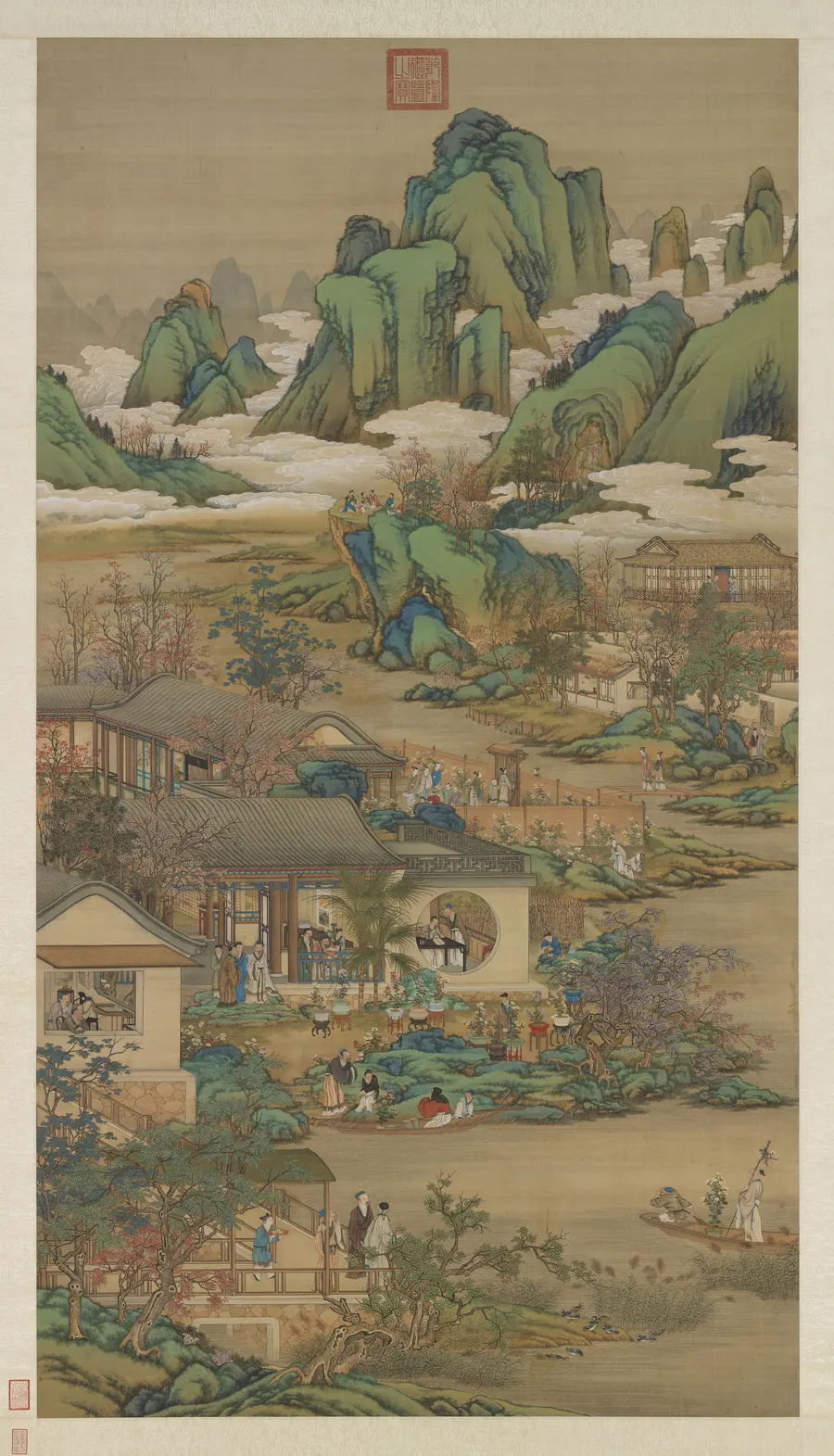
Viewing chrysanthemums and climbing to high ground mark the Double Ninth in the ninth lunar month, often near Cold Dew.
-
13 · Opens the Monkey month
Start of Autumn 立秋
Start of Autumn opens the Monkey month in the classical calendar long before leaves turn gold. Noon still feels unmistakably like summer, though anyone sitting outdoors after dusk notices a drier, lighter touch in the breeze.
Mist condenses on early morning grass and late-season cicadas take up a thinner, clearer call from high branches. Outward expansion has passed its peak, and both fields and households begin turning scattered summer effort toward harvest.
Across northern China, families traditionally gather for rich meat dishes to "put on autumn weight" after the lighter meals of high summer.
- 凉风至First cool breezes touch the air.
- 白露降White dew descends in the early morning.
- 寒蝉鸣Autumn cicadas call from cooling trees.
Practice: Step outdoors after supper tonight to feel the evening air on your bare forearms and notice how dusk has shifted since July.
-
14 · Mid-month term
End of Heat 处暑
In classical Chinese, the first character of End of Heat means to pause or come to rest, and this solar term marks the week when oppressive summer humidity finally steps back.
Nights grow noticeably refreshing, skies lift high above the plains, and heads of millet, sorghum, and early rice bow heavy with ripe grain. Hawks patrol open harvest fields under crisp light while wind carries the dry scent of straw across quiet village lanes.
Traditional almanacs mark these days as the true halting of summer heat, when farming villages prepare threshing grounds to welcome the ripening grain harvest.
- 鹰乃祭鸟Hawks lay out the birds they catch.
- 天地始肃Heaven and earth turn clear and austere.
- 禾乃登Standing grain ripens across the fields.
Practice: Open windows on opposite sides of your home after sunset so stale late-August warmth drifts cleanly out of your rooms.
-
15 · Opens the Rooster month
White Dew 白露
White Dew opens the Rooster month in the classical calendar during the widest daily temperature swings of the year. Sunlight warms courtyard stones through the afternoon, then clear skies let heat slip rapidly away after dark, turning night moisture into bright white droplets on grass and garden leaves by dawn.
Overhead, wild geese arrive in V-shaped lines while summer swallows head south and woodland birds tuck away nuts and seeds for the cold months ahead.
Tea lovers traditionally prize White Dew tea picked from bushes tempered by warm September sun and dewy nights, as mornings and evenings turn brisk.
- 鸿雁来Wild geese arrive along the autumn sky.
- 玄鸟归Swallows take wing and depart.
- 群鸟养羞Flocks of birds store food for winter.
Practice: Hang a light jacket or woven scarf beside your front door so early morning errands meet the chill comfortably.
-
16 · Mid-month term
Autumn Equinox 秋分
Half a year after Spring Equinox, the sun crosses 180 degrees and divides light and darkness into equal twelve-hour halves across the world. From the morning after this threshold, northern nights stretch longer than days.
Summer thunder withdraws from the sky, burrowing insects pack fine clay around their winter doors, and shallow creeks drop cleanly in their banks. Mid-autumn fields stand gold with harvest and return the fruit of everything planted in spring rain.
Honored since 2018 as the Chinese Farmers' Harvest Festival, Autumn Equinox also frequently lands near the lunar Mid-Autumn Festival, when families gather beneath the full moon.
- 雷始收声Thunder withdraws its voice from the sky.
- 蛰虫坯户Burrowing insects seal their earthen doors.
- 水始涸Standing waters begin to dry and recede.
Practice: Cook a simple supper from fresh autumn market produce tonight and sit down to share it with phones out of reach.
-
17 · Opens the Dog month
Cold Dew 寒露
Cold Dew opens the Dog month in the classical calendar when autumn coolness sharpens toward the edge of frost. Dew clinging to stone steps and dry reeds feels icy to the touch at sunrise, and late flocks of migrating geese settle along quiet marshes like traveling guests.
Summer flowers have long vanished from garden beds, while hardy chrysanthemums open bright yellow petals right into the cold October wind across northern courtyards.
Families traditionally gather to admire blooming chrysanthemums, and because the lunar Double Ninth Festival often falls near Cold Dew, people climb hills and high towers for sweeping autumn views.
- 鸿雁来宾Later flocks of geese gather like guests.
- 雀入大水为蛤As ancients saw it, sparrows enter seas as clams.
- 菊有黄华Chrysanthemums open their bright yellow blooms.
Practice: Walk up to the highest park overlook, hilltop, or open terrace near your home to look out across the crisp October horizon.
-
18 · Mid-month term
Frost's Descent 霜降
Closing the six turns of autumn, Frost's Descent marks the threshold where clear night air chills ground moisture directly into delicate ice crystals. Rooftops, bridge planks, and harvested stubble gleam silver before sunrise, then thaw clean in pale morning light.
Orchard and forest trees drop their yellow and russet leaves to blanket roots below, while burrowing creatures bow into winter stillness underground. Open harvest season now steps quietly indoors before November cold.
As trees shed their autumn leaves, households traditionally enjoy ripe persimmons sweetened on the branch by the late-October chill.
- 豺乃祭兽Jackals lay out their quarry before winter.
- 草木黄落Yellowed leaves let go and fall.
- 蛰虫咸俯Insects bow still inside their winter burrows.
Practice: Sweep fallen leaves from your front step or balcony today and bring tender potted plants indoors before the first hard freeze.
Season IV · Winter
225° to 300° · Boar, Rat & Ox Months
Winter
To classical eyes, winter is the great season of deep storage. Across northern plains, ponds glaze over with ice, plowed soil hardens under snow, and bare branches stand quiet against short pale days. Nothing essential in nature has disappeared.
Trees, fields, and rivers have drawn their Chi down into deep roots, stored seeds, sheltered burrows, and warm underground springs where surface frost never reaches. Across these six solar terms, Yin deepens week by week until Winter Solstice brings the longest night of the year.
Right inside that darkest midnight, a fresh thread of Yang stirs beneath the frozen ground and daylight begins its slow return north. Traditional households met winter by mending door drafts, filling grain jars, banking the kitchen stove, and keeping evenings unhurried, trusting deep rest through cold months to feed everything that spring will soon ask to grow.
Qing Dynasty Winter Scrolls 清代岁寒双轴
Art Institute of Chicago · National Palace Museum, Taipei
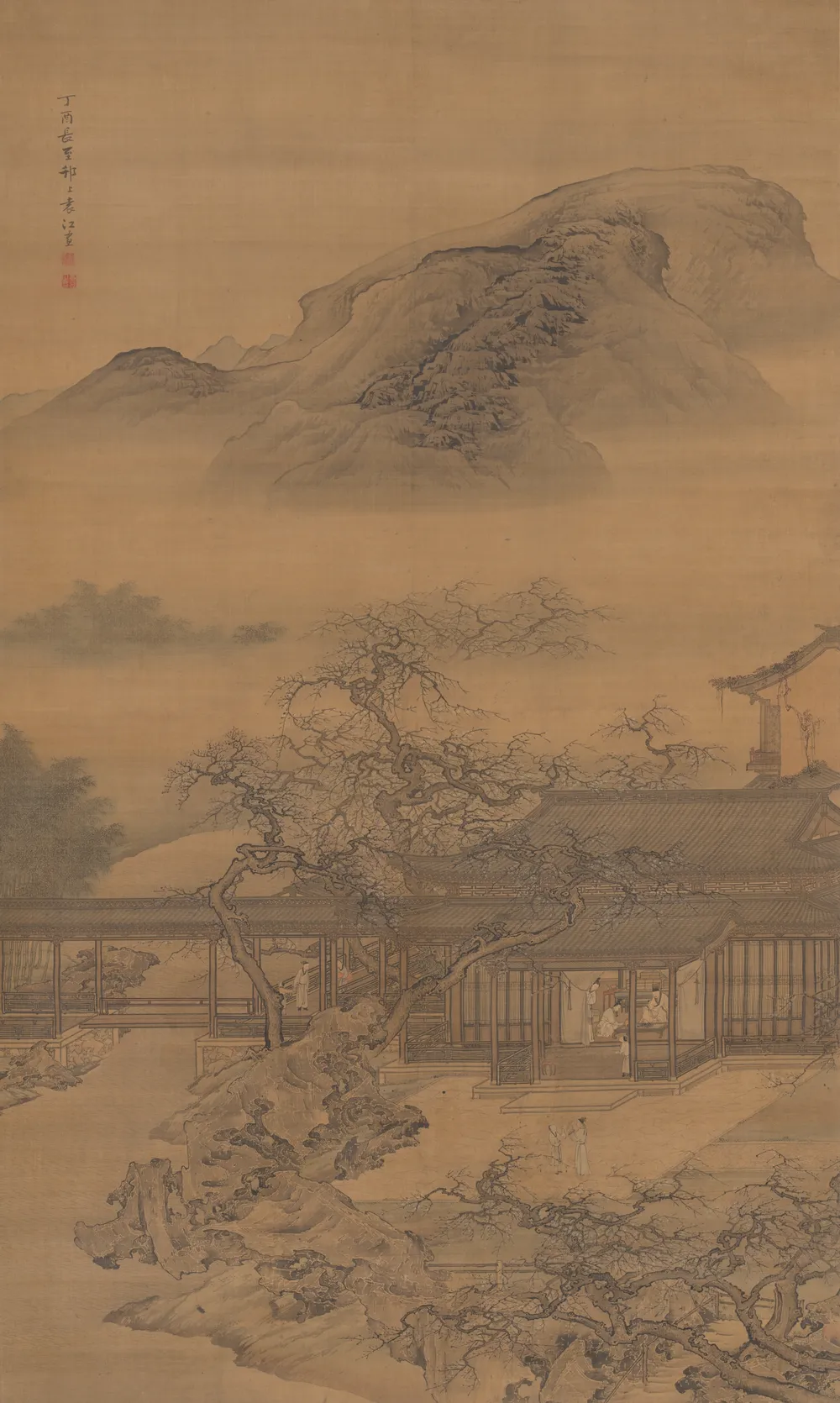
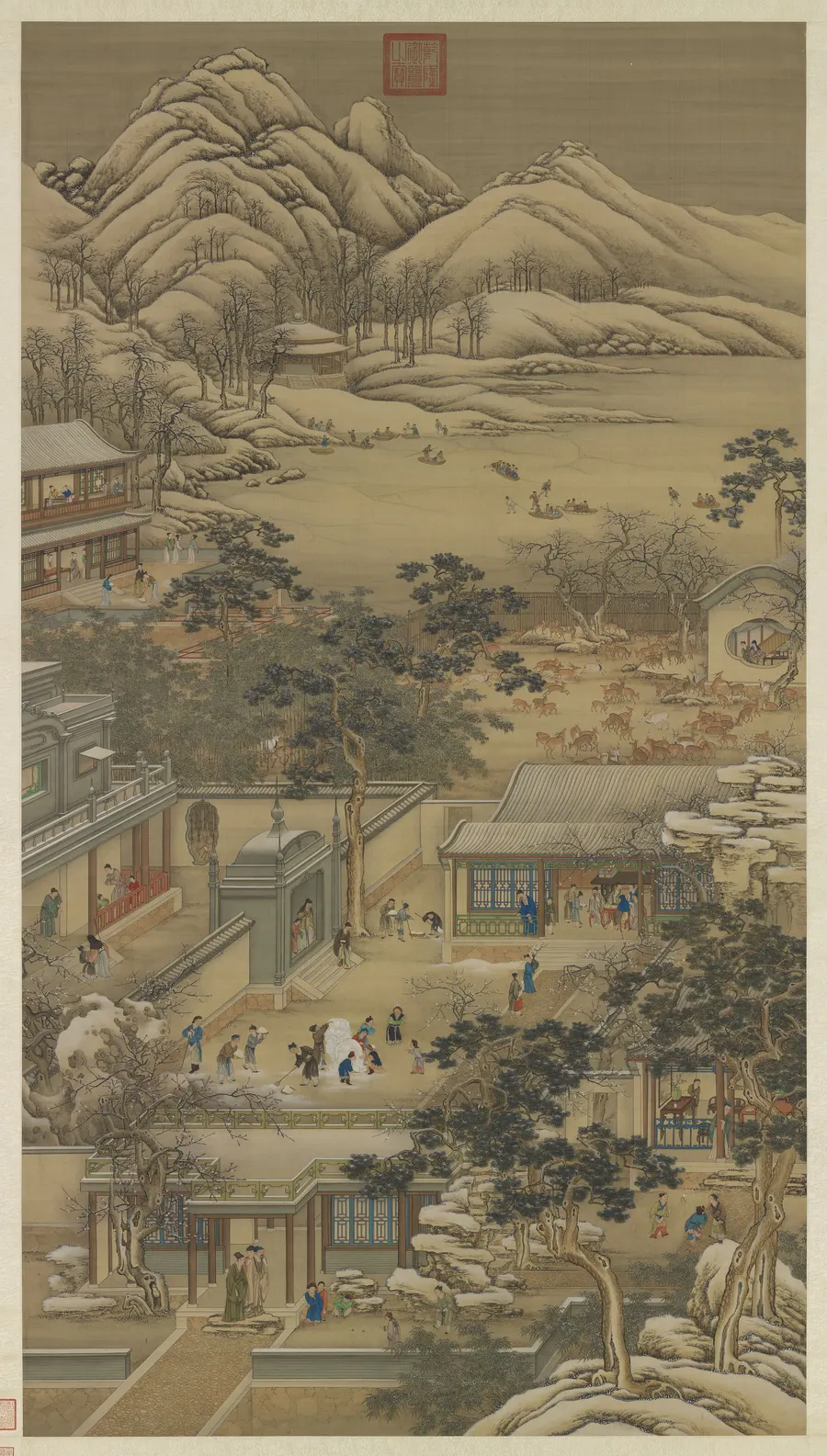
-
19 · Opens the Boar month
Start of Winter 立冬
Start of Winter opens the Boar month in the classical calendar once autumn crops are tucked safely into granaries. Along the Yellow River, shallow puddles crust with thin ice at daybreak and garden soil firms up under cold wind.
In classical agricultural language, winter means the end of the year's fieldwork and bringing harvests into storage. Nature closes its outer doors, and households slow evening schedules to gather warmth around the hearth.
Northern households traditionally fold hot dumplings at the seasonal hinge between autumn and winter, while southern families gather over hearty seasonal dishes to welcome the cold months.
- 水始冰Thin ice forms on quiet water.
- 地始冻Surface soil begins to freeze firm.
- 雉入大水为蜃In old lore, pheasants enter waters as giant clams.
Practice: Simmer a pot of soup at home this week and invite one close friend or family member over for an unhurried evening indoors.
-
20 · Mid-month term
Minor Snow 小雪
As the sun reaches 240 degrees, cold air presses southward and early flurries dust rooftops and bare branches across northern China, often melting gently on contact with soil that still holds a trace of autumn warmth.
Rainbows vanish until spring rain returns. In one of the most evocative lines of the old almanac, heaven's clear breath rises high while earth's heavy breath sinks deep, and the landscape settles into quiet winter stillness.
Taking advantage of crisp, dry air and falling temperatures, families traditionally begin curing pork and hanging seasoned winter sausages beneath sheltered eaves.
- 虹藏不见Rainbows vanish from the winter sky.
- 天气上升地气下降Heaven's breath rises while earth's breath sinks.
- 闭塞而成冬All things close inward, and winter is made.
Practice: Dim bright ceiling lights an hour after sunset tonight and let a single warm table lamp carry the rest of your evening.
-
21 · Opens the Rat month
Major Snow 大雪
Major Snow opens the Rat month in the classical calendar as snowfalls grow heavier and stay longer on northern fields and roofs. Even night-calling mountain birds go quiet in the cold.
Inside that deep winter stillness, classical observers already spotted subtle signs of turning life, as tigers begin seeking mates in quiet forests and tough iris shoots push green tips up through chilled earth ahead of the approaching solstice.
Across northern China, folk tradition speaks of Major Snow sealing rivers under thick ice, turning frozen waterways into winter sled paths while households gather indoors.
- 鹖鴠不鸣The winter night bird falls silent.
- 虎始交Tigers begin to court in deep woods.
- 荔挺出Hardy iris shoots push through cold earth.
Practice: Set warm socks beside your bed tonight and protect one weekend morning from alarms or outside errands.
-
22 · Mid-month term
Winter Solstice 冬至
When the sun reaches 270 degrees, the Northern Hemisphere meets its shortest daylight and longest night of the year. Surface cold will continue sharpening through January, while underground springs already sense the sun reversing northward and stir with faint warmth.
Classical China revered this invisible hinge so deeply that an old proverb calls Winter Solstice "as great as the New Year." Like Clear and Bright in spring, it is both an astronomical solar term and a cherished family festival.
Honoring the return of light, northern families traditionally eat dumplings, southern households share sweet glutinous rice balls in warm broth, and people begin "counting the nines" of winter by tinting one petal or brush stroke daily across an eighty-one-day winter chart.
- 蚯蚓结Earthworms curl in tight knots underground.
- 麋角解Elk shed their old antlers.
- 水泉动Deep springs begin to move underground.
Practice: Draw nine small circles on a card beside your desk and shade one in every nine days until eighty-one days carry you into spring.
-
23 · Opens the Ox month
Minor Cold 小寒
Minor Cold opens the Ox month, the twelfth and final animal month of the classical solar year, just as stored ground warmth runs low and the coldest weeks of winter set in across the north.
Bare treetops already show birds responding to the slowly lengthening daylight that human skin barely feels. Wild geese orient northward, magpies weave fresh twig nests facing away from winter wind, and pheasants call across frozen furrows.
Entering the coldest stretch of the year, Minor Cold often lands near the traditional eighth-day festival of the twelfth lunar month, when households simmer pots of warm winter porridge.
- 雁北乡Wild geese turn their faces northward.
- 鹊始巢Magpies begin weaving their new nests.
- 雉始雊Pheasants call out across frosty fields.
Practice: Hold your morning mug of tea or coffee in both palms for a quiet minute before stepping out into January air.
-
24 · Mid-month term
Major Cold 大寒
At 300 degrees of solar longitude, Major Cold brings the twenty-four solar terms full circle. Lakes and marshes freeze solid to their center, hawks cut swiftly through thin winter air, and brooding hens warm early eggs inside sheltered coops.
Having traveled every step from February thaw through summer rain and autumn harvest, the year pauses in clean stillness, sweeping its threshold clear so Start of Spring can open a fresh ring fifteen days later.
Closing out the solar year, families traditionally sweep away a full year's dust from beams and corners and stock markets and pantries with provisions for the approaching Lunar New Year.
- 鸡始乳Hens begin to lay and brood.
- 征鸟厉疾Birds of prey strike swift and fierce.
- 水泽腹坚Lakes and marshes freeze solid to the heart.
Practice: Empty one cluttered drawer today and let go of what has served its purpose so the solar year closes with open space.
Archival Field Notes 物候集解
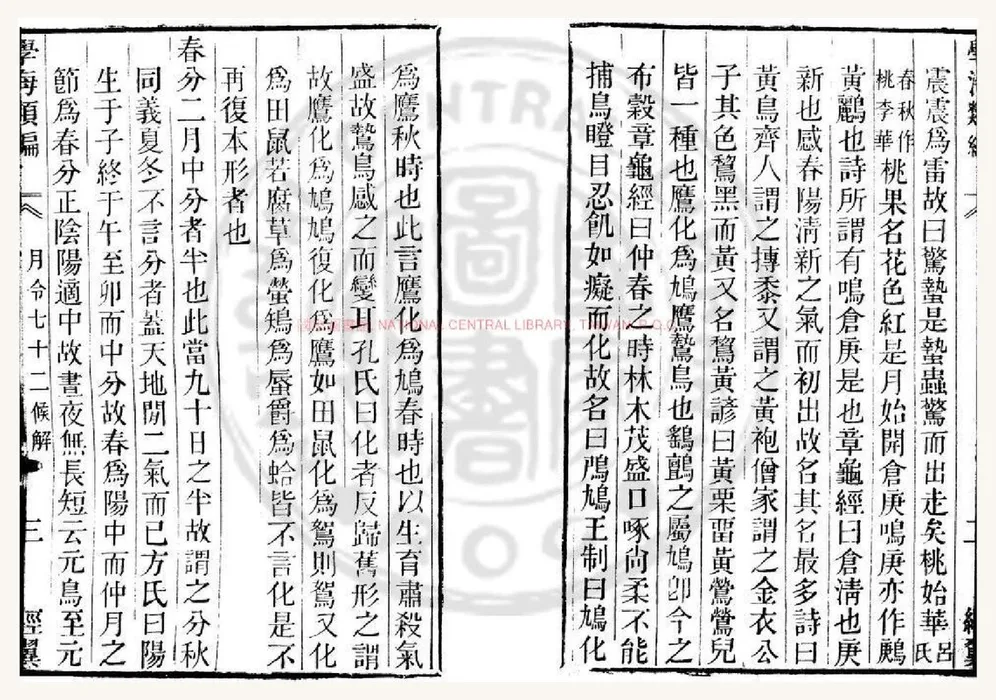
The seventy-two pentads
Inside every fifteen-day solar term sit three smaller steps of roughly five days each, known in English as pentads. Across a full year, those seventy-two pentads form China's oldest nature diary, preserved in early classics including the Lost Book of Zhou and the Book of Rites, and explained entry by entry in the fourteenth century by the Yuan scholar Wu Cheng.
Instead of counting time in abstract numbers, ancient observers watched their living neighbors, noting when east wind loosened river ice, when swallows returned beneath the eaves, when cicadas began singing, and when chrysanthemums opened yellow petals in October cold.
A few entries preserve the poetic eye of pre-modern field lore, recording hawks softening into doves in spring or sparrows vanishing into autumn surf just as clams appeared along the tideline. Read in the spirit of ancient observation, they show how closely people once watched shore, field, and sky.
Five days is small enough for any modern person to feel. Even on a city street, noticing which week street trees bud or evening light shifts brings our attention gently home to the season.
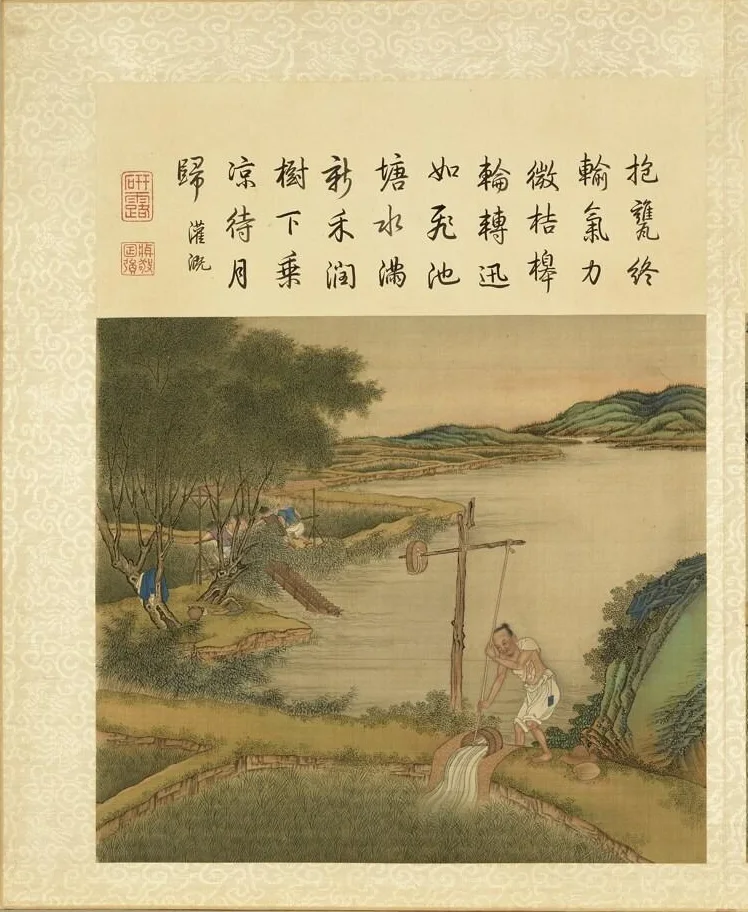
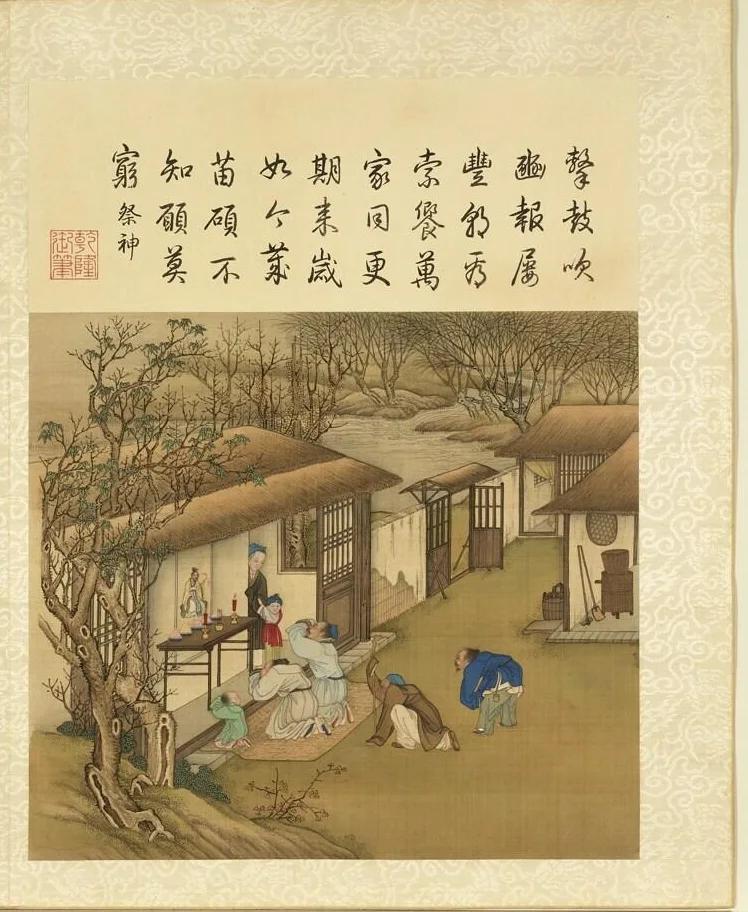
Plates XV & XVIChen Mei, Pictures of Tilling and Weaving (Irrigation and Offering Thanks leaves), 1739, National Palace Museum, Taipei. Farmers work treadle waterwheels to irrigate fields and offer thanks to heaven after autumn harvest along the solar calendar.
Tilling & Harvest 御製耕織圖
The farmer's calendar
Before scholars brushed poems about mountain mist, the twenty-four solar terms belonged to people with mud on their boots. Along the Yellow River, planting too early meant losing tender shoots to frost, while reaping wheat three days late could surrender a ripe field to summer storms.
Every name carried plain work, from spring plowing at Awakening of Insects and watering millet at Grain Rain to cutting bearded wheat while setting rice into flooded paddies at Grain in Ear.
Chen Mei's 1739 album Pictures of Tilling and Weaving honors that devotion, showing farmers pedaling waterwheels in summer and thanking heaven after autumn harvest, a tradition marked since 2018 at Autumn Equinox as the Chinese Farmers' Harvest Festival.
From the Study
Ancient astronomers watched noon shadows lengthen and shorten because every wise decision begins by noticing what season you actually stand in.
Master Lee
07 · Classical Timing
How the solar terms shape classical timing
Many newcomers to Eastern traditions assume the classical Chinese calendar turns its months by the moon. Festival dates certainly follow lunar phases, which is why Lunar New Year lands on a different date between late January and mid-February each year.
Classical Taoist timing arts follow a stricter astronomical clock set directly by the sun.
Recall that the twenty-four solar terms alternate between twelve month-opening nodes (节) and twelve mid-month midpoints (中气). In the classical stem-and-branch calendar, every month opens at the exact minute the sun crosses a month-opening node, never on the first day of the lunar month and never on January 1.
Start of Spring opens the Tiger month around February 4. Awakening of Insects opens the Rabbit month in early March. Clear and Bright opens the Dragon month in early April, continuing around all twelve animal months until Minor Cold opens the Ox month in January.
Both Four Pillars birth charts and Qi Men Dun Jia follow these solar thresholds down to the minute. If a child is born in late January before Start of Spring arrives, a classical chart reads that birth year under the departing zodiac sign instead of the incoming one, even when Lunar New Year festivities have already begun.
Monthly pillars shift on those same twelve solar nodes, so a person's monthly alignment turns on Start of Autumn in early August or White Dew in early September instead of the first day on a wall calendar.
Qi Men Dun Jia goes one step deeper by calibrating its entire structure to the solar year. From Winter Solstice, when daylight begins lengthening again, its charts unfold along an ascending Yang cycle, and from Summer Solstice, when light subtly turns inward, its charts shift into a descending Yin cycle.
Those movements pass down through a living lineage, and nobody reading this needs to calculate them by hand. Whenever Master Lee opens a chart for your month ahead or for a crossroad in your life, these twenty-four solar terms are the quiet clock ticking underneath every reading.

Printable Wall Reference 二十四节气总览
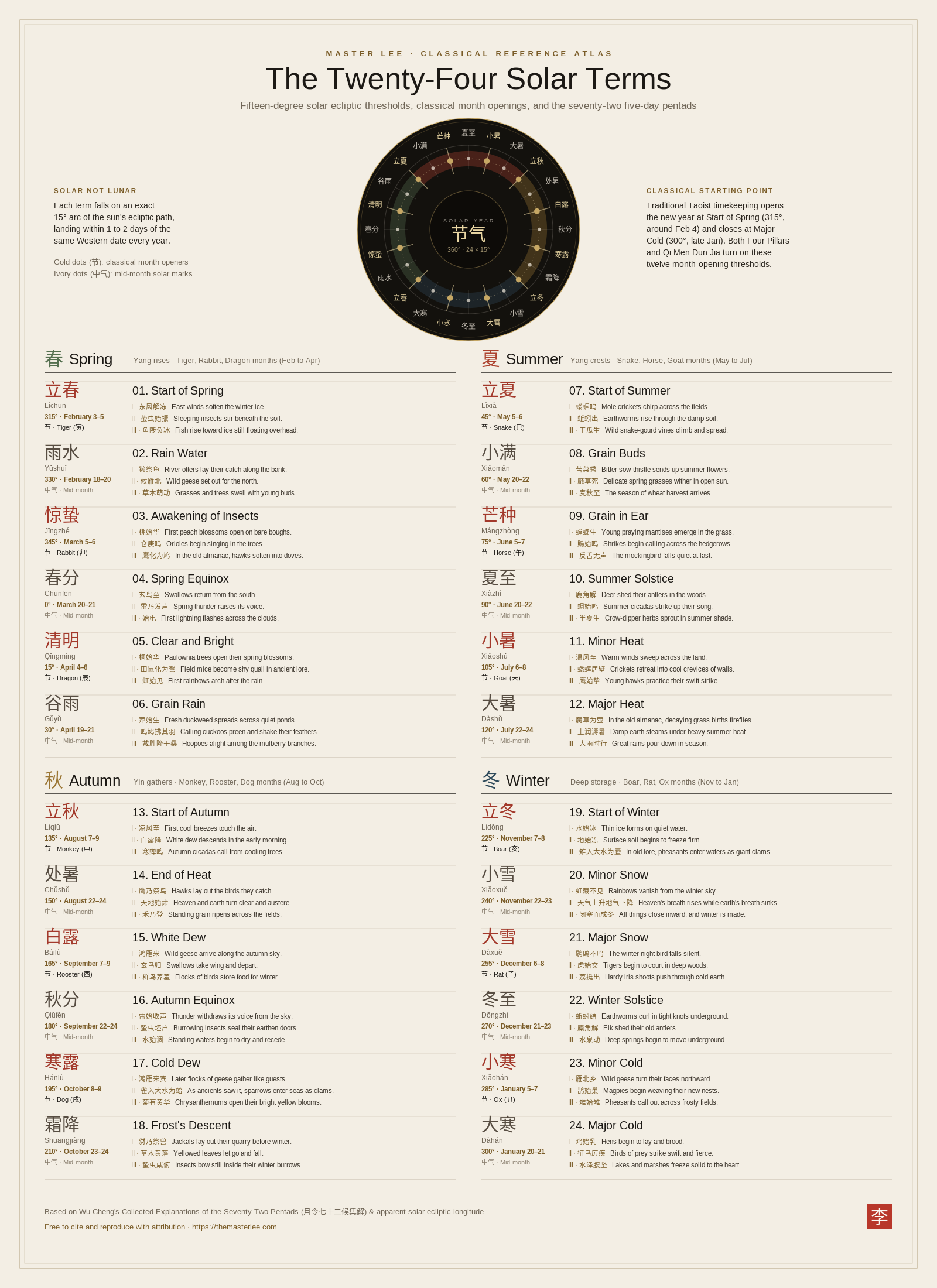
Complete 24 solar terms reference chart
Free to download, print, and share in classrooms or publications. Please credit Master Lee and include a link back to themasterlee.com.

Each month opens on one of these solar thresholds, and each month money and love enter your home from a new direction.
Questions people ask
- What are the 24 solar terms in order?
- In classical order beginning with spring, the six spring terms are Start of Spring, Rain Water, Awakening of Insects, Spring Equinox, Clear and Bright, and Grain Rain. Summer continues with Start of Summer, Grain Buds, Grain in Ear, Summer Solstice, Minor Heat, and Major Heat. Autumn brings Start of Autumn, End of Heat, White Dew, Autumn Equinox, Cold Dew, and Frost's Descent. Winter closes the circle with Start of Winter, Minor Snow, Major Snow, Winter Solstice, Minor Cold, and Major Cold.
- Are the 24 solar terms part of the lunar calendar?
- They belong wholly to the solar calendar. Lunar months follow the waxing and waning moon from new moon to new moon, whereas the 24 solar terms divide the sun's 360-degree annual path into exact fifteen-degree steps. Traditional Chinese almanacs print both systems side by side, which is why people often call the combined calendar lunisolar, while the solar terms themselves track the sun alone.
- When does the Chinese year begin in classical Taoism?
- Popular celebrations mark Lunar New Year on the new moon between late January and mid-February, so its date shifts every year. Classical Taoist arts, including Four Pillars birth charts and Qi Men Dun Jia, begin the new solar year at the exact astronomical minute of Start of Spring, around February 4, when the sun crosses 315 degrees of longitude and early spring Chi begins rising.
- Why is Winter Solstice so important in Chinese culture?
- An old Chinese saying holds that "Winter Solstice is as great as the New Year." Arriving around December 21 to 23 on the shortest day of the year in the Northern Hemisphere, it marks the quiet turning point where Yin reaches its peak and Yang daylight begins lengthening again. Families gather across China to celebrate, sharing dumplings in the north and sweet glutinous rice balls in warm broth in the south.
- Do the 24 solar terms work in North America or the Southern Hemisphere?
- Astronomically, each solar term occurs at one shared global instant, which often lands a calendar day earlier on North American clocks than in Beijing because of time zones. Ecologically, the classical nature notes grew out of China's Yellow River basin, per the Hong Kong Observatory. Readers in warmer latitudes or the inverted seasons of the Southern Hemisphere can honor the sun's exact turning points while observing the real weather outside their own doors.
- Which of the 24 solar terms are traditional festivals?
- Only two solar terms are also major traditional festivals in their own right, Clear and Bright in early April, when families sweep ancestral graves and walk in green countryside, and Winter Solstice in late December, when households reunite for winter feasts. Since 2018, China has also celebrated Autumn Equinox as the Chinese Farmers' Harvest Festival. Other famous holidays like Dragon Boat, Mid-Autumn, and Double Ninth follow lunar dates that drift near neighboring solar terms.
- How do the 24 solar terms connect to Qi Men Dun Jia?
- The solar terms are the underlying clock of Qi Men Dun Jia. Twelve month-opening terms turn the twelve solar months of the stem-and-branch calendar, governing when monthly energies shift, while Winter Solstice and Summer Solstice mark the two great hinges between the art's ascending Yang cycle and descending Yin cycle. Whenever Master Lee reads a chart, he calibrates the moment against these exact solar thresholds.
Historical sources & museum provenance
Primary & Institutional References
- UNESCO Intangible Cultural Heritage (2016): The Twenty-Four Solar Terms, knowledge in China of time and practices developed through observation of the sun's annual motion, Nomination No. 00647.
- Hong Kong Observatory: The 24 Solar Terms, 15° ecliptic longitudes and Central Plains climate.
- Masters of Huainan (淮南子·天文训), c. 139 BCE, Ch. 3 "Celestial Patterns" (trans. Major et al., Columbia UP).
- Book of Rites (礼记·月令) & Lost Book of Zhou (逸周书·时训解), monthly pentads (Legge trans., Vol. 27).
- Wu Cheng (吴澄), Collected Explanations of the Seventy-Two Pentads (月令七十二候集解).
Museum Plates & Public Domain Credits
- Plate IHero Plate (P-hero): New Year’s Market in a Time of Peace (丁觀鵬《太平春市圖》), Ding Guanpeng, 1742. National Palace Museum, Taipei. Public domain · Record
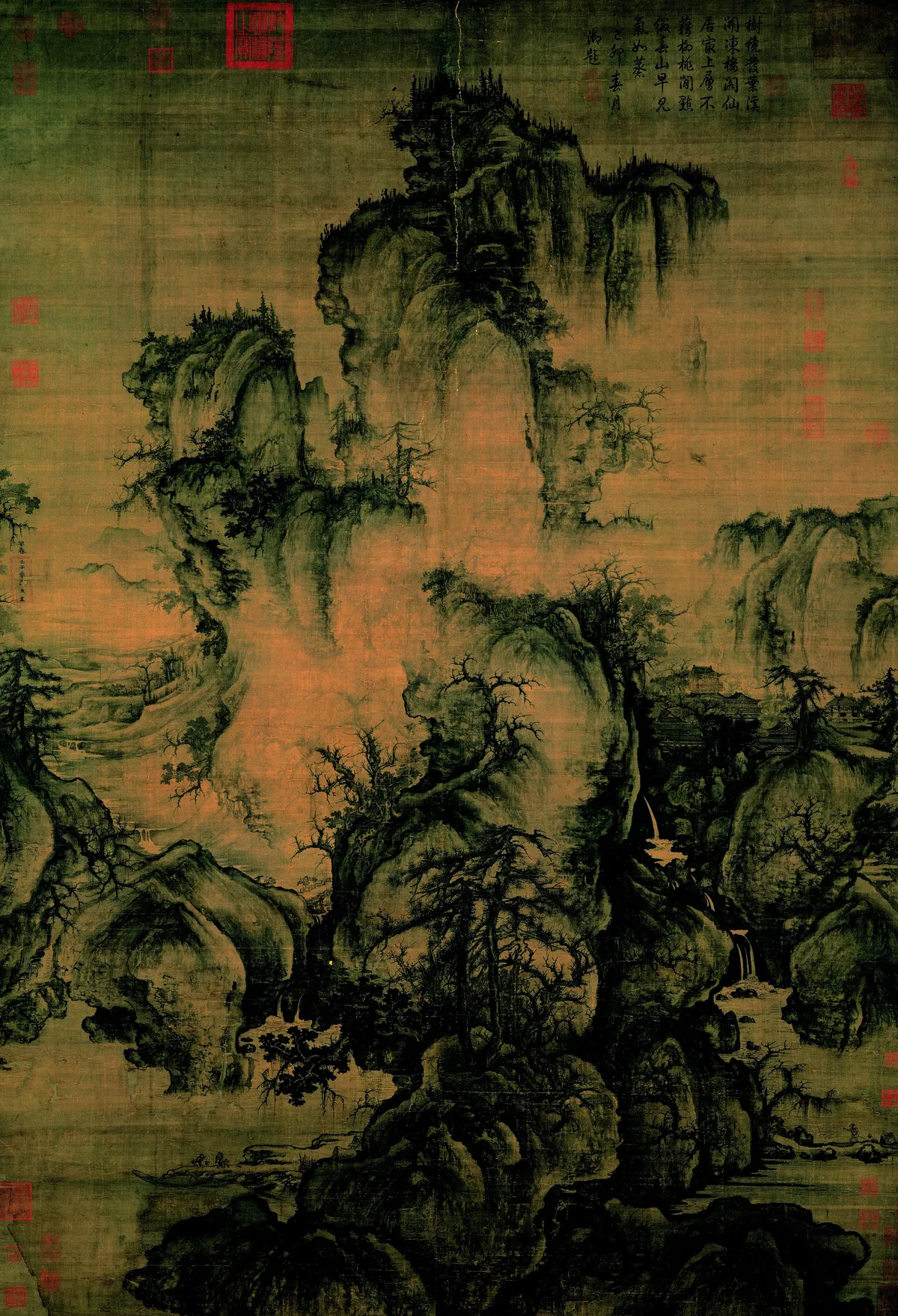
- Plate IISpring Lead Plate (P-spring): Early Spring (郭熙《早春圖》), Guo Xi, 1072. National Palace Museum, Taipei. Public domain · Record
- Plate IIISpring Gallery (P-m1): Activities of the Twelve Lunar Months: First Month (清院本十二月令圖 · 一月), Qing court painters, c. 1736 to 1737. National Palace Museum, Taipei. Public domain · Record
- Plate IVSpring Gallery (P-m2): Activities of the Twelve Lunar Months: Second Month (清院本十二月令圖 · 二月), Qing court painters, c. 1736 to 1737. National Palace Museum, Taipei. Public domain · Record
- Plate VSpring Gallery (P-m3): Activities of the Twelve Lunar Months: Third Month (清院本十二月令圖 · 三月), Qing court painters, c. 1736 to 1737. National Palace Museum, Taipei. Public domain · Record
- Plate VISummer Lead Plate (P-summer): Summer Mountains, Qu Ding, ca. 1050. The Metropolitan Museum of Art, 1973.120.1. Public domain (CC0) · Record
- Plate VIISummer Gallery (P-m5): Activities of the Twelve Lunar Months: Fifth Month (清院本十二月令圖 · 五月), Qing court painters, c. 1736 to 1737. National Palace Museum, Taipei. Public domain · Record
- Plate VIIISummer Gallery (P-m6): Activities of the Twelve Lunar Months: Sixth Month (清院本十二月令圖 · 六月), Qing court painters, c. 1736 to 1737. National Palace Museum, Taipei. Public domain · Record
- Plate IXAutumn Lead Plate (P-autumn): Autumn Colors on the Qiao and Hua Mountains (趙孟頫《鵲華秋色》), Zhao Mengfu, 1296. National Palace Museum, Taipei. Public domain · Record
- Plate XAutumn Gallery (P-m8): Activities of the Twelve Lunar Months: Eighth Month (清院本十二月令圖 · 八月), Qing court painters, c. 1736 to 1737. National Palace Museum, Taipei. Public domain · Record
- Plate XIAutumn Gallery (P-m9): Activities of the Twelve Lunar Months: Ninth Month (清院本十二月令圖 · 九月), Qing court painters, c. 1736 to 1737. National Palace Museum, Taipei. Public domain · Record
- Plate XIIWinter Diptych (P-dongzhi): Viewing Plum Blossoms with Warm Wine 溫酒賞梅圖, Yuan Jiang 袁江 (Chinese, active 1688 to 1746), Qing dynasty (1644 to 1911), 1717. The Art Institute of Chicago, 1944.437. Public domain (CC0) · Record
- Plate XIIIWinter Diptych (P-m12): Activities of the Twelve Lunar Months: Twelfth Month (清院本十二月令圖 · 十二月), Qing court painters, c. 1736 to 1737. National Palace Museum, Taipei. Public domain · Record
- Plate XIVHistorical Folio (72 Pentads): Collected Explanations of the Seventy-Two Pentads (吳澄《月令七十二候集解》), Wu Cheng (text), Yuan dynasty text, later printing. National Central Library, Taipei. Public domain · Record
- Plate XVFarming Plate I (P-farm): Pictures of Tilling and Weaving: Irrigation (陳枚《畫耕織圖》冊 · 灌溉), Chen Mei, 1739. National Palace Museum, Taipei. CC0 · Record
- Plate XVIFarming Plate II (P-farm): Pictures of Tilling and Weaving: Offering Thanks (陳枚《畫耕織圖》冊 · 祭神), Chen Mei, 1739. National Palace Museum, Taipei. CC0 · Record