Skip to content

The Year Ahead · 2027

Your 2027: The Year of the Hearth Lamp

Beginning at Start of Spring on February 4, 2027, the Ding Wei year sets a steady hearth lamp above late-summer soil, inviting closer light, grounded care, and clear rhythm across your home.

Start of Spring · in your time zone
February 4, 2027 · 9:46 am China time
—days—hours—minutes
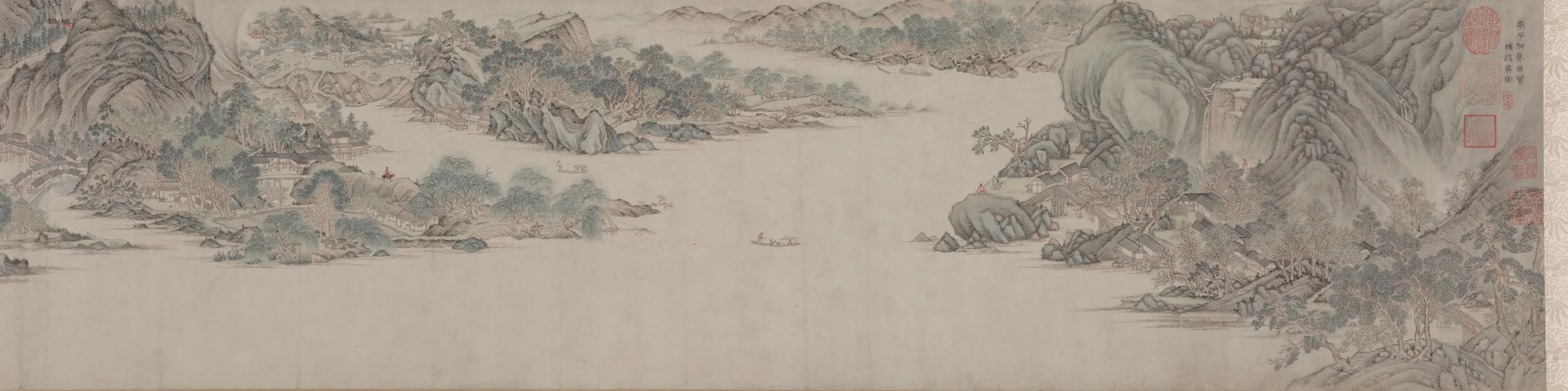
Blue-and-green washes open across a wide handscroll lined with riverside villages, pavilions, an arched bridge, distant hills, and small boats.

Plate IWu Bin, Greeting the Spring, 1600 (Ming dynasty), The Cleveland Museum of Art, 1959.45. Blue-and-green washes open across a wide handscroll lined with riverside villages, pavilions, an arched bridge, distant hills, and small boats.

丁
Yin Fire · The Hearth Lamp
未
Yin Earth · Late-Summer Soil
44
Of 60 in the Cycle
Feb 4
Start of Spring
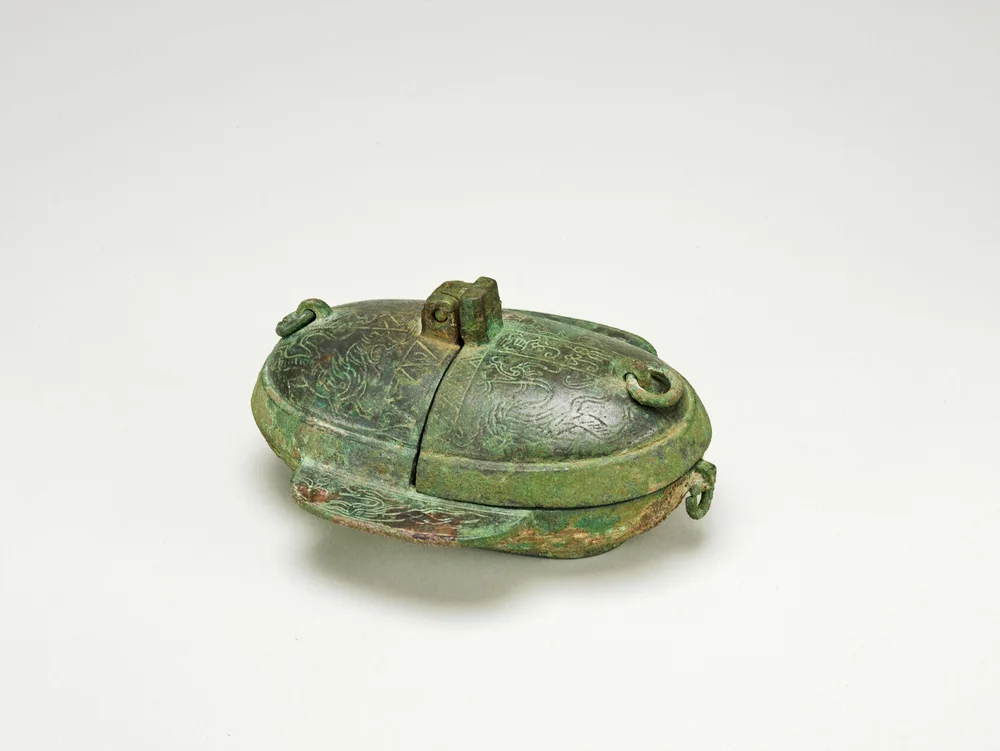
An oval bronze lamp from the Han dynasty fitted with a hinged lid that folds shut across green patina and incised ornament.
Plate IIUnidentified artist, Folding Oil Lamp, Han dynasty (206 BCE to 220 CE), The Art Institute of Chicago, 1930.907. An oval bronze lamp from the Han dynasty fitted with a hinged lid that folds shut across green patina and incised ornament.

01 · The Lamp & the Soil

What kind of year is 2027

At a Glance

  1. 01
    A hearth lamp over warm soil

    After 2026's wide open sun, 2027 (Ding Wei, Yin Fire over Yin Earth) draws heat inward into steady craft and quiet warmth.

  2. 02
    Turns on February 4, 2027

    The Ding Wei year opens at Start of Spring (9:46 am China time · February 3, 8:46 pm US Eastern), not at midnight on January 1.

  3. 03
    Bright center, quiet north

    Star 9 gathers warmth in the middle of the home while Southeast, Northwest, and South open the clearest rooms for steady work.

In the classical calendar, every year takes its character from two paired signs, one stem overhead and one branch underfoot. For 2027, those two characters are Ding Wei (丁未).

Overhead shines Ding, Yin Fire, known across Master Lee's work as The Hearth Lamp, a flame that holds a steady, intimate glow that guides one room through the night. Underfoot rests Wei, Yin Earth, the warm soil of late summer.

On the compass and sundial, Wei centers at 210 degrees in the south-southwest and corresponds to Sun's Decline from 1 pm to 3 pm, when courtyard ground holds the stored heat of early afternoon. Read together, those two signs give 2027 one clear image. A sheltered lamp rests above sun-warmed soil through the evening hours.

That image stands out beside the year just behind us. In 2026, the Bing Wu year stood under Bing Fire, The Morning Sun, pouring wide daylight across an entire valley at once.

Stepping into 2027, all that broad brightness draws inward into one calm flame beside an evening table. The light grows closer, steadier, and far more concentrated. A hearth lamp leaves the distant ridge to the night air and lights what sits directly within reach of your hands.

You see the open page on your desk, the warm meal waiting at the table, and the faces of the people sharing your room each night.

In English calendars and everyday conversation, 2027 is commonly called the Year of the Fire Goat. In ancient Taoism, masters look directly to the stem and branch Ding Wei rather than an animal emblem, because those two characters name the elemental weather of the twelve months.

Yin Fire shines above, Yin Earth settles below, and warmth gathers close to home across all four seasons, giving households a clear image to live beside from February through next winter.

Reading the image of a year serves a practical purpose. Classical timing observes the terrain ahead first so a household can move with the seasonal current instead of pushing against closed doors. When the year's light is a lamp above garden soil, hurried scatter gives way to deliberate care close at hand.

You stand on firm ground in 2027 when you tend one room well, nourish roots already planted in good soil, and let daily attention build lasting strength week after week across the entire year.


The Solar Year 十二节气月

When 2027 begins

Wall calendars turn at midnight on January 1, and red lanterns go up for Chinese New Year on February 6, 2027, the first new moon of the lunar year. That lunar calendar runs cleanly through twelve moon cycles without a leap month, reaching the full moon of the Mid-Autumn Festival on September 15, 2027.

In the solar calendar of ancient Taoism, however, the Ding Wei year opens two days before Lunar New Year at the exact minute of Start of Spring (立春). That threshold arrives on February 4, 2027, at 9:46 am China time, which lands on the evening of February 3, 2027, at 8:46 pm US Eastern time, and holds the sky until the next Start of Spring on February 4, 2028, at 3:31 pm China time.

Master Lee follows Start of Spring because classical timing tracks the warmth of the sun along its annual path alongside seasonal Chi rising from the ground.

At that exact minute in early February, Four Pillars charts change their annual pillar, Qi Men Dun Jia turns its seasonal plate, and the Nine-Palace map shifts across every home at once. Both New Years belong to authentic tradition. Chinese New Year gathers families under the new moon to celebrate renewal together, while Start of Spring marks the solar turn used for reading time, birth pillars, and household space.

The seasonal scroll below automatically reads the time zone on your device and displays the exact minute each of the twelve solar months of 2027 begins where you live.

Brushed in monochrome ink across a paper handscroll, blossoms of all four seasons unfold in clear sequence from spring to winter.
春Spring夏Summer秋Autumn冬Winter
  1. 立春寅Start of Spring
  2. 惊蛰卯Awakening of Insects
  3. 清明辰Clear and Bright
  4. 立夏巳Start of Summer
  5. 芒种午Grain in Ear
  6. 小暑未Minor Heat
  7. 立秋申Start of Autumn
  8. 白露酉White Dew
  9. 寒露戌Cold Dew
  10. 立冬亥Start of Winter
  11. 大雪子Major Snow
  12. 小寒丑Minor Cold
  13. Chinese New Year · Feb 6

Plate VIChen Jiayan, Flowers of the Four Seasons, dated 1599 (Ming dynasty), The Art Institute of Chicago, 1951.186. Brushed in monochrome ink across a paper handscroll, blossoms of all four seasons unfold in clear sequence from spring to winter.

Five-Element Weather 火生土 · 天河水

The five-element weather of 2027

Every stem-and-branch year carries an inner relationship between sky and ground. In 2027, Ding Fire sits directly above Wei Earth, so the stem feeds the branch in one downward current. Fire shines overhead and Earth rests underfoot, moving in the natural direction of the generating cycle where one phase nourishes the next.

Like an oil lamp set upon an earthen stove, the flame above warms and enriches the ground beneath it without glare or wasted fuel. Energy settles smoothly from clear light into receptive soil, helping daily attention take tangible form across home life and craft.

Looking closer at the branch below, Wei opens its solar month at Minor Heat in early July, right as summer ripens toward late summer. Classical study observes three hidden stems resting inside Wei Earth.

Its primary Chi is Ji (己), Yin Earth, The Garden Soil that receives rain patiently and turns small seeds into nourishment. Two other stems also dwell inside that rich loam.

Ding (丁) preserves the lingering glow of The Hearth Lamp, and Yi (乙), Yin Wood, carries The Flowering Vine that bends gracefully in strong wind and finds sunlight around stone. Beneath the surface of 2027 lies late-summer soil holding the afterglow of a lamp and one living vine root.

On the sixty-pillar wheel of the classical calendar, Ding Wei stands as the 44th combination, returning sixty years after 1967 and one hundred twenty years after 1907, before coming round again in 2087.

Ancient scholars also gave every consecutive pair of years a shared sound-image in the almanac. Both 2026 (Bing Wu) and 2027 (Ding Wei) carry the image of Heavenly River Water, the Milky Way arching high across a summer night sky.

Above two consecutive Fire years flows a ribbon of cool water, reminding every household to leave evening stillness and rest above the day's effort.

丁
Ding · Yin FireThe Hearth Lamp
未
Wei · Yin EarthLate-summer soil, holding warmth
己Garden Soil丁Lamp's warmth乙Vine root
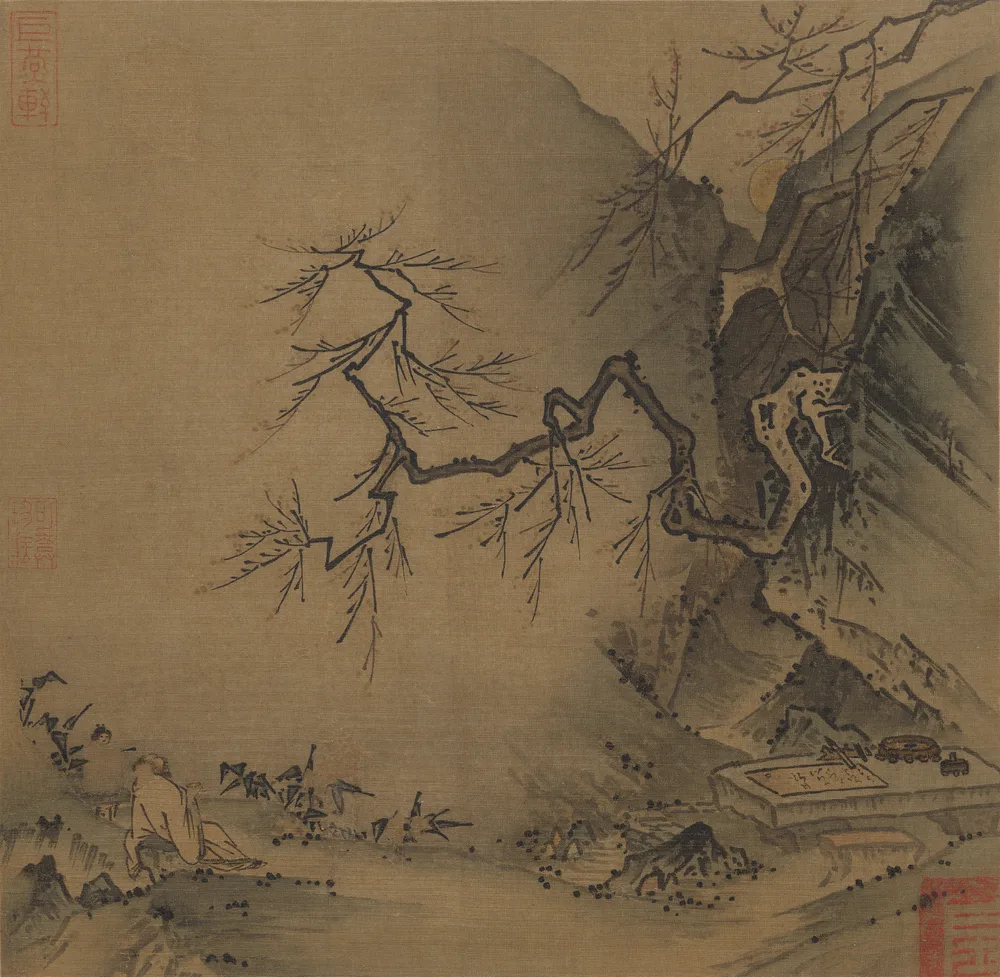
On a silk leaf, a scholar sits on a slope beneath an angled branch beside wine vessels resting on stone.
Plate VMa Yuan, Drinking in the Moonlight, late 1100s to early 1200s (Southern Song dynasty), The Cleveland Museum of Art, 1997.89. On a silk leaf, a scholar sits on a slope beneath an angled branch beside wine vessels resting on stone.

Na Yin 纳音

天河水

Heavenly River Water, shared by 2026 and 2027

The sixty-pair cycle with Ding Wei as the forty-fourth pair 甲子 · 1 丁未 · 44 60PAIRS IN ONE CYCLE 1907 · 1967 · 2027 · 2087
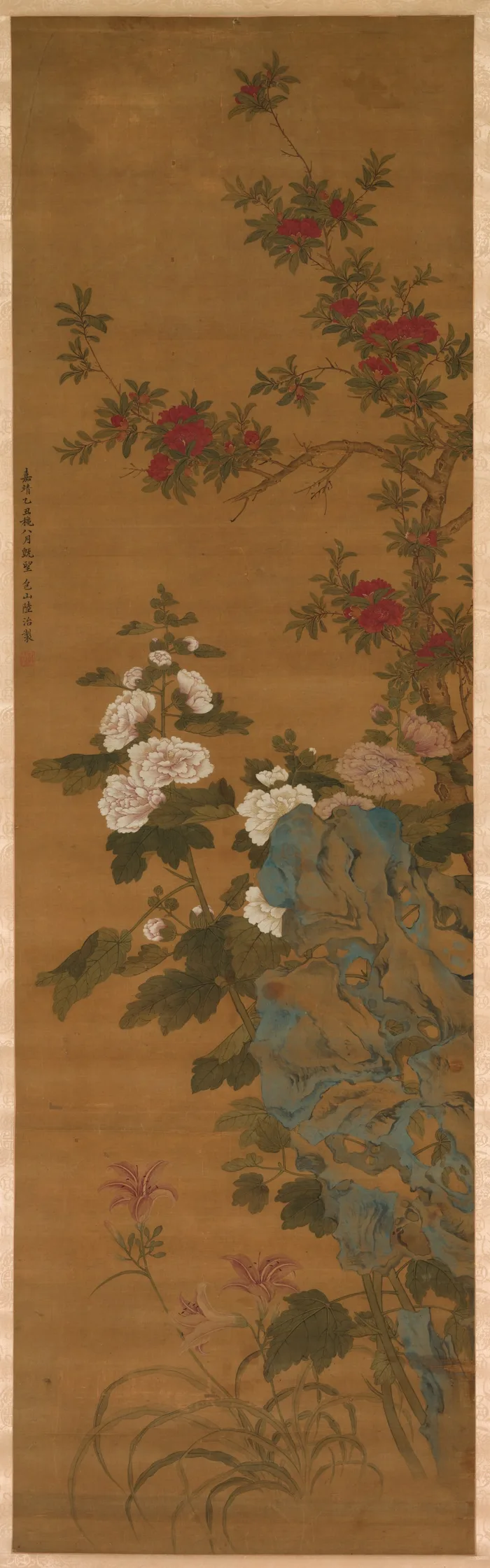
Flowering branches heavy with red and white blossoms rise beside garden rock in ink and color on a silk scroll.
Plate IIIUnidentified artist, Flowers and Rocks, 1368 to 1644 (Ming dynasty), The Cleveland Museum of Art, 1915.116. Flowering branches heavy with red and white blossoms rise beside garden rock in ink and color on a silk scroll.
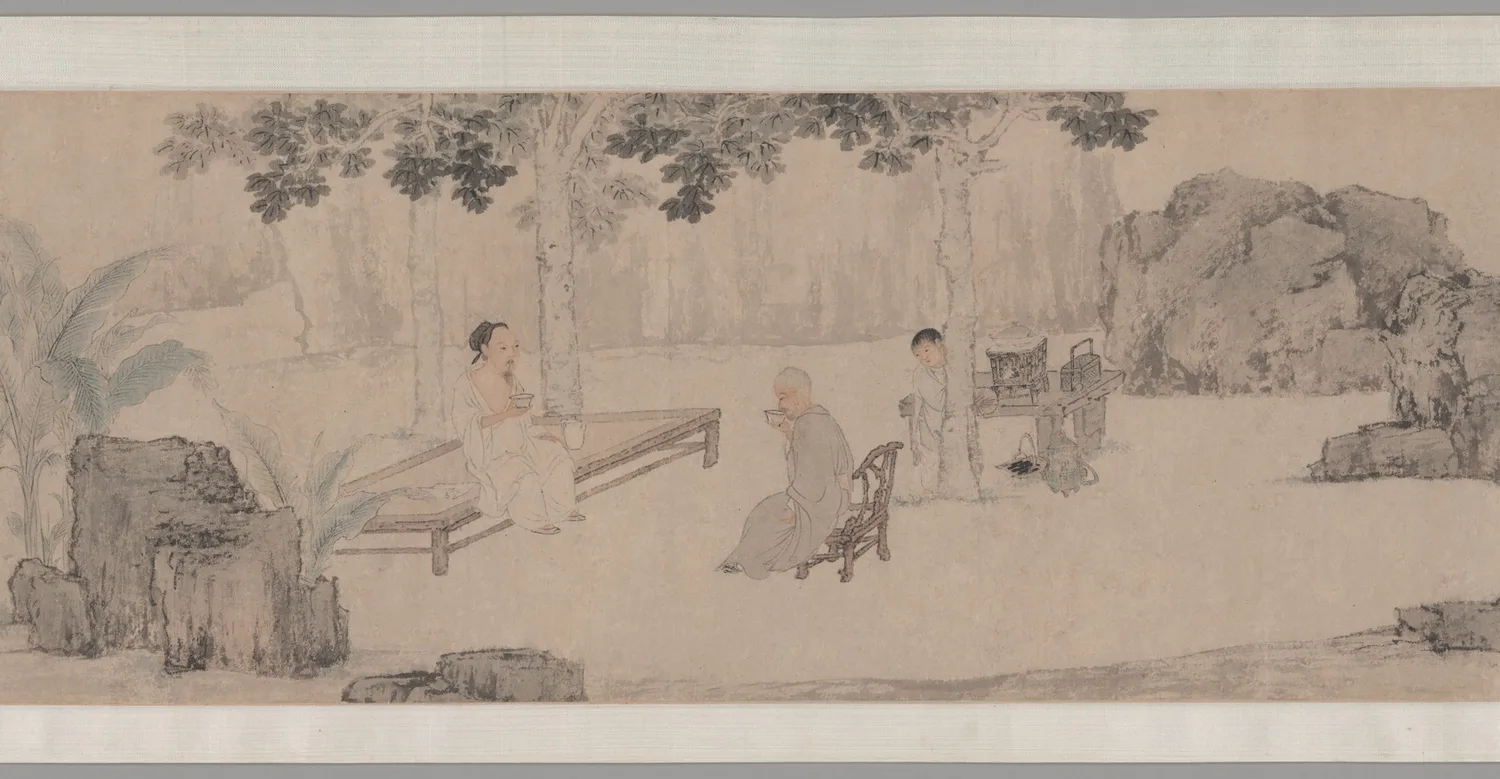
On a paper handscroll, a scholar sits on a couch beneath a wutong tree beside an attendant, rock, and banana leaves.
Plate IVTang Yin, Tea Drinking Under the Wutong Tree, 1509 (Ming dynasty), The Art Institute of Chicago, 1941.13. On a paper handscroll, a scholar sits on a couch beneath a wutong tree beside an attendant, rock, and banana leaves.

Four Seasons of 2027 四时

The year, season by season

Spring

Feb 4 Start of SpringMar 6 Awakening of InsectsApr 5 Clear and Bright

Spring opens the solar ring in rising Wood Chi across Start of Spring on February 4, Awakening of Insects on March 6, and Clear and Bright on April 5, crossing equal day and night at the Spring Equinox in late March.

Damp earth loosens after frost and young branches lean toward morning light in the east. Meeting 2027's image of a hearth lamp above garden soil, spring's supple Wood feeds the Ding flame overhead without haste.

Early plans and creative drafts take root indoors beside a sunlit window before reaching outward into open air across the courtyard.

Tend: Open east windows for five minutes each morning after waking, clear winter coats and parcels from the entryway, and protect one quiet hour in the morning for focused work before reading messages.

Summer

May 6 Start of SummerJun 6 Grain in EarJul 7 Minor Heat

Summer climbs into full Fire across Start of Summer on May 6 and Grain in Ear on June 6, cresting in the longest daylight of the year at the Summer Solstice in late June.

On July 7, Minor Heat opens the Wei month, when the branch of Ding Wei itself steps forward to govern the season. More than any other thirty-day span on the calendar, this July stretch shows 2027 in its truest color, as noon heat sinks deep into late-summer soil.

Outward blaze softens into stored warmth held beneath the surface of daily life.

Tend: Draw light curtains across south and west windows during afternoon heat from 1 pm to 3 pm, sip warm tea or water slowly, and dim bright ceiling lights early each evening.

Autumn

Aug 8 Start of AutumnSep 8 White DewOct 8 Cold Dew

Autumn brings clear Metal air across Start of Autumn on August 8, White Dew on September 8, and Cold Dew on October 8, passing the Mid-Autumn moon on September 15 and equal day and night at the Autumn Equinox in late September.

Along the generating cycle, Wei Earth feeds Metal directly, turning summer's stored heat into clean contour and ripened grain. Under 2027's hearth lamp, dense foliage thins back to bare branch lines.

That seasonal turn sets an unhurried rhythm for keeping what endures across the years and clearing surface noise from the evening table.

Tend: Clear summer clutter off desks and kitchen counters, finish small repairs around the house before taking on new commitments, and set one stoneware bowl or table lamp on your dining table.

Winter

Nov 7 Start of WinterDec 7 Major SnowJan 6 Minor Cold

Winter settles into Water stillness across Start of Winter on November 7, Major Snow on December 7, the longest night of the year at the Winter Solstice in late December, and Minor Cold in January, closing when Start of Spring arrives on February 4, 2028.

Outside the window, fields rest beneath frost and sap retreats underground. Inside the house, 2027's image of a hearth lamp above garden soil comes into clear focus against early dusk.

Sheltered walls hold evening warmth while dark earth stores nourishment out of sight for the coming solar ring.

Tend: Keep evening rooms free of drafts and lit by soft lamps, rest thirty minutes earlier around December's longest nights, and leave open space on your January calendar before February 4 arrives.

Your Rooms in 2027

Walk through the nine compass rooms of your own home

Tap any room on our interactive 2027 map to see where light gathers, where to keep quiet, and how to prepare for the Ding Wei year.

Letters from Master Lee

Receive Master Lee's quiet notes when each solar month turns, plus early previews of Your Month Ahead.

From the Study

A warm hearth year rewards steady craft, clear agreements, and the quiet discipline of tending what already stands before you.

Master Lee

The 2027 Home Map 九宫飞星

Your home in 2027

From Start of Spring on February 4, 2027, the Flying Star map brings the Ninth Star (9, Gathering & Joy) home to the Center of every floor plan.

Because we now stand inside the twenty-year Ninth Period (2024 to 2043) governed by this Fire star, keeping the middle of your house open, uncluttered, and welcoming sets the tone for the whole household all year.

Around that center, the brightest sectors to use often for desks, reading, and daily work are the Southeast (8, Steady Harvest), Northwest (1, Clear Flow), and South (4, Open Study). The Southwest (6, Wise Counsel) also carries bright clarity, and because the Grand Duke rests there as well, it rewards dignified order without loud disturbance.

The North (5, Deep Stillness) and the West (2, Restorative Pause, which also holds the resting arc of the Seasonal Restraints) both ask for simplicity and low clutter throughout 2027. Along the compass slices of the Grand Duke in the south-southwest (202.

5° to 217. 5°) and the Year Breaker opposite it in the north-northeast (22. 5° to 37. 5°), everyday living, sleeping, cooking, and desk work continue completely as normal, while wall demolition or ground digging waits for another year. To check your front door, bedroom, and desk across all nine palaces, open The 2027 Nine-Palace Home Map.

Open the full 2027 home map

South at the top, as in the classical nine-palace map. Tap any room to open the full map.

For the Whole Year 守灯五事

Five ways to live with the lamp

  1. 一

    Switch to one evening lamp

    Thirty minutes after sunset each night, turn off ceiling lights and switch on one table lamp in the room your household shares. Soft light gathers everyone's attention around the evening table before sleep.

  2. 二

    Keep the middle table clear

    Spend five minutes each evening clearing mail, keys, and parcels off your dining or coffee table. Leave one green plant or ceramic bowl resting at the center of your floor plan.

  3. 三

    Honor the early afternoon hours

    Between 1 pm and 3 pm, the hours of Wei when afternoon heat sinks into the ground, step away from errands for a cup of tea and give detailed craft your full attention.

  4. 四

    Tend one root in good soil

    Choose one study, craft, or body of work each season and return to it at the same hour every day. Consistent care lets real roots take hold in fertile ground without strain.

  5. 五

    Leave cool sky above your day

    Remembering Heavenly River Water arching across the night sky of this year, set phones and screens aside thirty minutes before bed and take three slow breaths beside an open window each night.

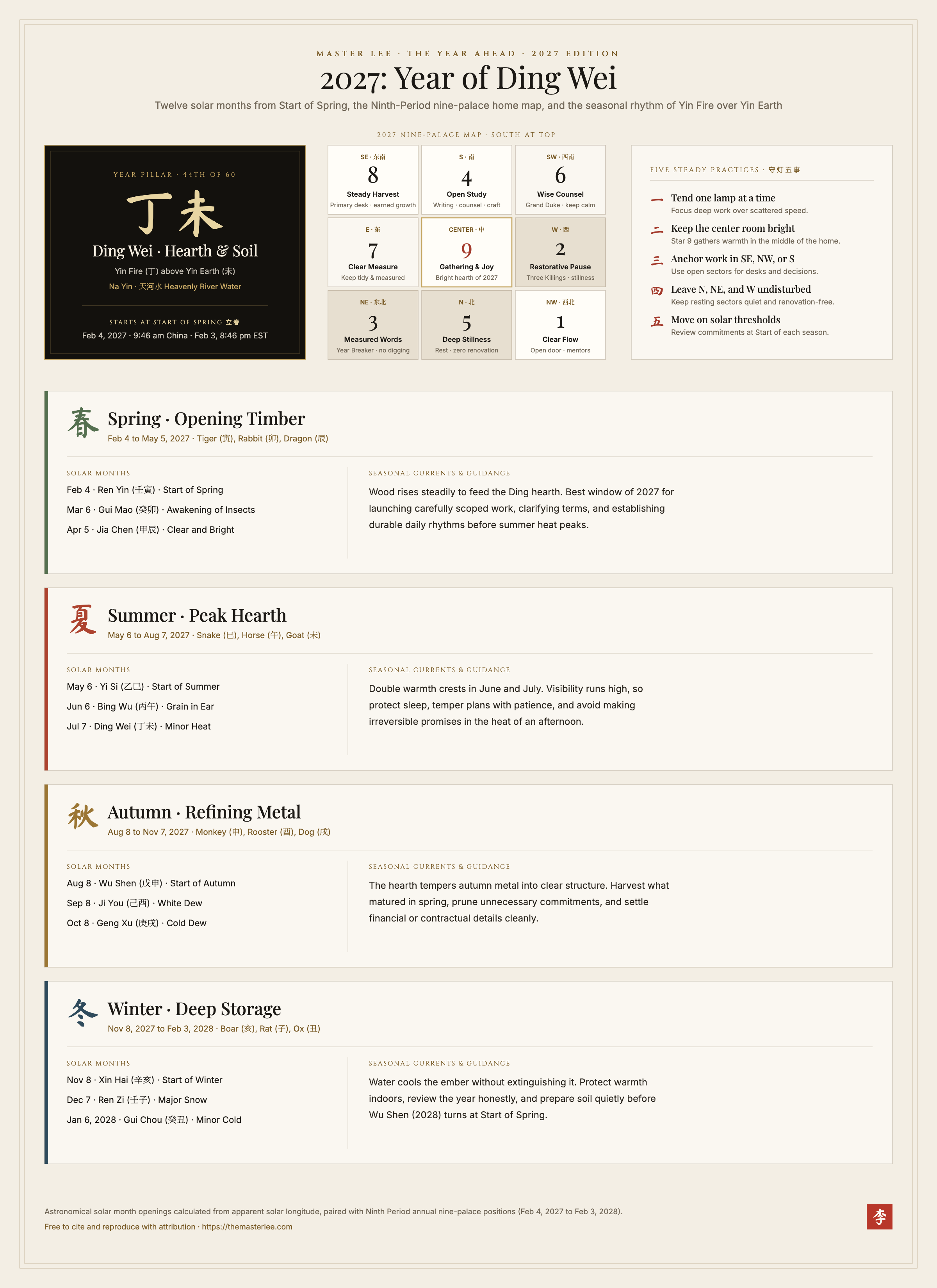
2027 Ding Wei: The Year Ahead Reference Chart illustrated by Master Lee

Printable Wall Reference 丁未岁时总图

Printable 2027 Ding Wei Year & Home Reference Chart

Keep the full 2027 rhythm in view from Start of Spring on February 4, 2027 through February 3, 2028: all twelve solar months, four seasonal turning points, the nine-palace home map, and the five steady practices of a Ding Wei year.

2400 × 3300 Print PNGEditable Vector SVG12 Months · Nine Palaces

The hearth lamp above warm soil sets the shared climate for every household in 2027. How your own twelve months unfold, and where your clearest openings stand, belongs to your personal chart.

Questions people ask

When does the Chinese year 2027 start?
In the classical calendar used for Four Pillars charts, Flying Star home maps, and Qi Men Dun Jia, 2027 begins at Start of Spring on February 4, 2027, at 9:46 am China time, which corresponds to February 3 at 8:46 pm US Eastern time. Chinese New Year arrives two days later on February 6, 2027, and the solar year continues until Start of Spring on February 4, 2028, at 3:31 pm China time.
What element is 2027 in the Chinese calendar?
In the classical calendar, 2027 is the Ding Wei year, pairing Yin Fire overhead with Yin Earth underfoot. Because traditional calendars name each year first by its stem, English guides introduce 2027 as a Fire year, pictured across Master Lee's work as The Hearth Lamp. Paired with late-summer Wei Earth below and the sound-image of Heavenly River Water, the year blends focused warmth with grounded stillness.
Is 2027 a Fire year or an Earth year?
Every classical year carries two phases working side by side, one stem above and one branch below. In 2027, the stem Ding is Yin Fire and the branch Wei is Yin Earth, so both elements shape the twelve months together. Here the stem feeds the branch, meaning lamp Fire nourishes receptive Earth beneath it, uniting clear focus overhead with patient ground underfoot.
What does Ding Wei mean?
Ding Wei (丁未) is the 44th stem-and-branch pillar in the sixty-year calendar cycle, seen sixty years ago in 1967, earlier in 1907, and returning next in 2087. Ding names Yin Fire, The Hearth Lamp that holds a steady, intimate glow guiding one room through the night. Wei names Yin Earth, late-summer soil centered at 210 degrees in the south-southwest and linked with early afternoon from 1 pm to 3 pm.
Why does Master Lee start the year at Start of Spring instead of Chinese New Year?
Chinese New Year follows the lunar calendar, gathering households under the new moon on February 6, 2027. Taoist timing arts track seasonal Chi governed by the sun's position along its annual path. When the sun reaches Start of Spring on February 4, 2027, birth pillars, seasonal charts, and home compass sectors all shift at once. Both celebrations honor real traditions built for distinct purposes.
How should I prepare my home for 2027?
Before Start of Spring on February 4, 2027, clear clutter from the Center of your floor plan where the Ninth Star (Gathering & Joy) returns all year. Use the Southeast, Northwest, and South regularly for desks and daily study, keep the Southwest calm and dignified, and let the North and West stay simple while saving wall renovation in the south-southwest, north-northeast, and west for another year.

Historical sources & museum provenance

Classical Texts

  • Start of Spring 2027: February 4, 2027, 9:46 am China time (February 3, 8:46 pm US Eastern), computed from the sun's apparent longitude and checked against published almanac times.
  • Na Yin (纳音): the classical sound images of the sixty pairs, in which Bing Wu and Ding Wei share Heavenly River Water.
  • The 2027 nine-palace map: annual stars for the Ninth Period (2024 to 2043), as published on Your Home in 2027.

Museum Plates & Public Domain Credits

  • Plate IHero Plate (Greeting the Spring): Greeting the Spring, Wu Bin, 1600. The Cleveland Museum of Art, 1959.45. Public domain (CC0) · Record
  • Plate IIThe Hearth Lamp: Folding Oil Lamp, China, Han dynasty, 206 BCE–220 CE. The Art Institute of Chicago, 1930.907. Public domain (CC0) · Record
  • Plate IIILate-Summer Ground: Flowers and Rocks, Unidentified artist, 1368 to 1644. The Cleveland Museum of Art, 1915.116. Public domain (CC0) · Record
  • Plate IVLate-Summer Ground: Tea Drinking Under the Wutong Tree (唐寅《桐荫品茗图》), Tang Yin, Ming dynasty (1369 to 1644), 1509. The Art Institute of Chicago, 1941.13. Public domain (CC0) · Record
  • Plate VHeavenly River Water: Drinking in the Moonlight, Ma Yuan, late 1100s to early 1200s. The Cleveland Museum of Art, 1997.89. Public domain (CC0) · Record
  • Plate VIThe Year Ribbon: Flowers of the Four Seasons 四季花卉圖 (陈嘉言《四季花卉图》), Chen Jiayan, Ming dynasty (1368 to 1644), dated 1599. The Art Institute of Chicago, 1951.186. Public domain (CC0) · Record

Keep reading