01 · Meaning & Origins
What Wu Xing actually means
At a Glance
- 01
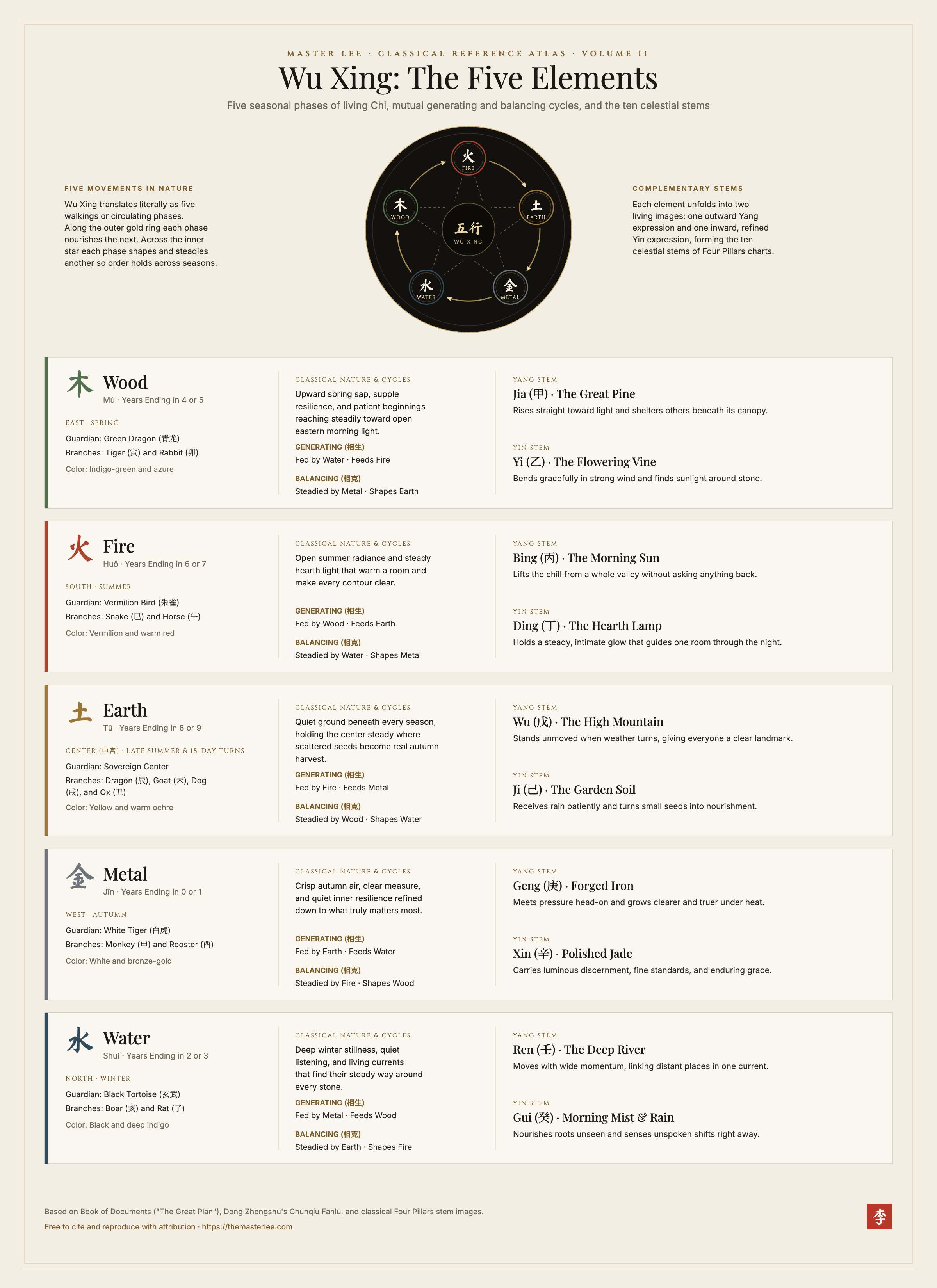
Five movements, not static substancesWu Xing describes how living Chi rises, brightens, settles, refines, and stores across every season.
- 02
Two simultaneous cyclesAlong the outer ring each phase feeds the next (相生), while across the inner star each phase shapes and steadies another (相克).
- 03
Ten living stemsEvery element divides into an outward Yang image and an inward Yin image, forming the ten Day Masters of classical charts.
English translations usually render Wu Xing (五行) as the Five Elements, a phrase that invites Western readers to picture five static building blocks like the earth, air, fire, and water of ancient Greece.
In classical Chinese, the character wu means five and xing means to walk, step forward, or circulate along an open path. Early observers looked out across wooded hillsides, river valleys, and courtyard eaves and recognized five active phases of living Chi passing continuously from one seasonal state into the next.
Wood, Fire, Earth, Metal, and Water name distinct ways energy moves through the natural world, never five isolated piles of raw matter sitting still on a shelf.
The earliest surviving written definition of those five qualities appears in "The Great Plan," a foundational chapter of the ancient Book of Documents. Each phase is introduced entirely through how it behaves in tangible nature.
Water cools, moistens, and seeks the lowest ground. Fire kindles, clarifies, and climbs upward. Wood bends, stretches, and reaches toward light. Metal yields to the forge and holds a clean edge.
Earth receives seed and yields harvest at the center. Every classical line points to an everyday motion anyone can watch outdoors, from rain sinking into low garden soil to young green branches leaning toward morning sun.
Over several centuries, scholars and court astronomers wove these field observations into one coherent calendar and cosmology. During the Warring States period, Zou Yan (c. 305 to 240 BCE) linked the rotation of the five virtues with seasonal turns and the succession of dynasties.
Late Warring States ritual compendia, including Master Lü's Spring and Autumn Annals (c. 239 BCE) and the "Monthly Ordinances" chapter of the Book of Rites, paired spring, summer, autumn, and winter with Wood, Fire, Earth, Metal, and Water taking orderly turns across the solar year.
In the second century BCE, the Western Han thinker Dong Zhongshu set forth in Luxuriant Dew of the Spring and Autumn Annals the paired rhythms of mutual generating and mutual balancing that keep living systems steady.
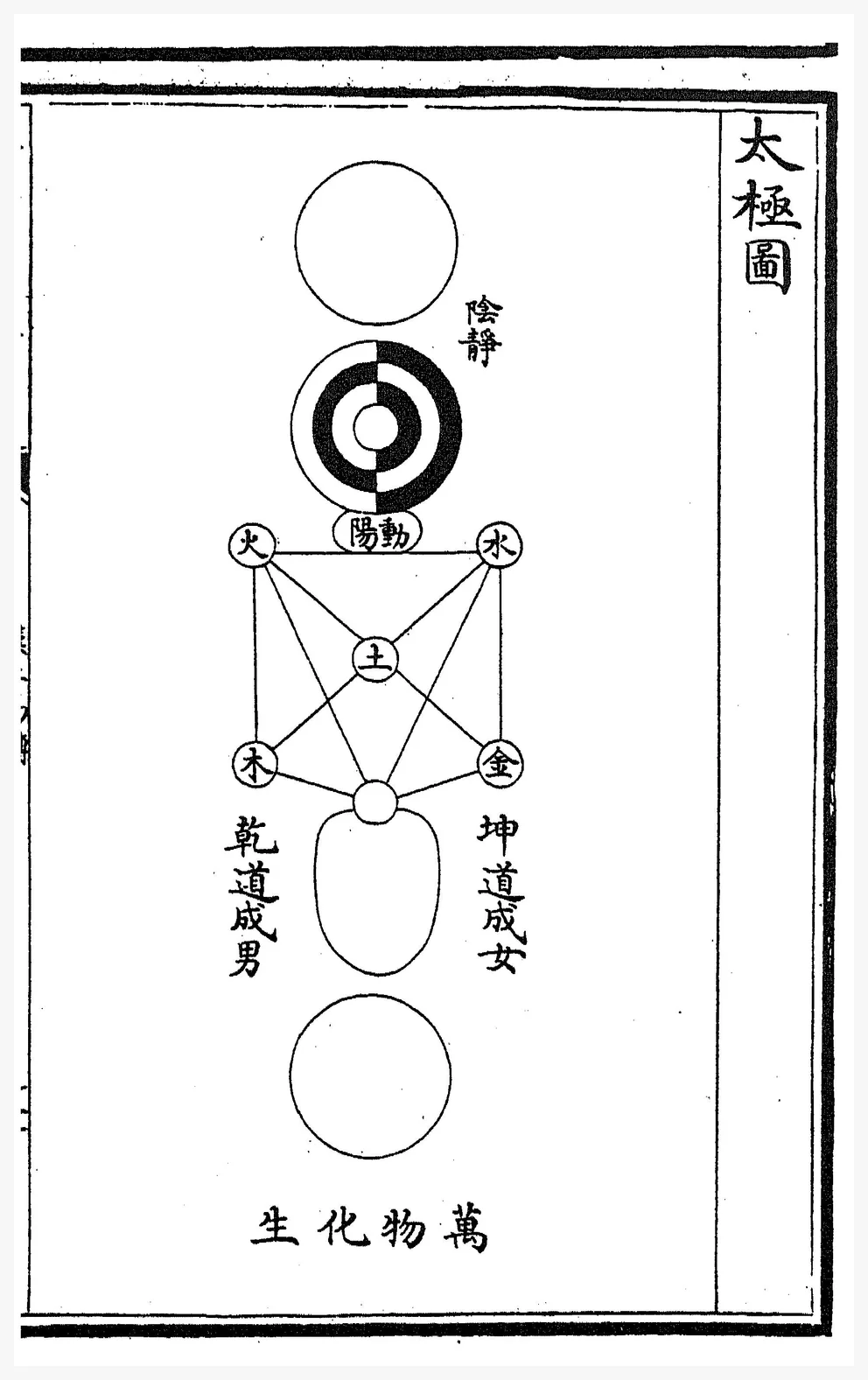
Centuries later, Northern Song philosopher Zhou Dunyi (1017 to 1073) explained in his Explanation of the Diagram of the Supreme Ultimate how the Supreme Ultimate differentiates into Yin and Yang, whose alternating stillness and motion give birth to the five phases of Chi so the four seasons unfold without pause.
Because this classical framework tracks relationship and timing together, one shared vocabulary came to join time, space, material craft, and human character. The same five phases mark the turning of the solar year, orient the four compass quarters around a calm center, guide potters, joiners, and bronze founders in honoring natural materials, and give ancient Taoism a clear everyday language for reading our own temperament alongside the living season right outside the front door.