- What are the 12 Earthly Branches?
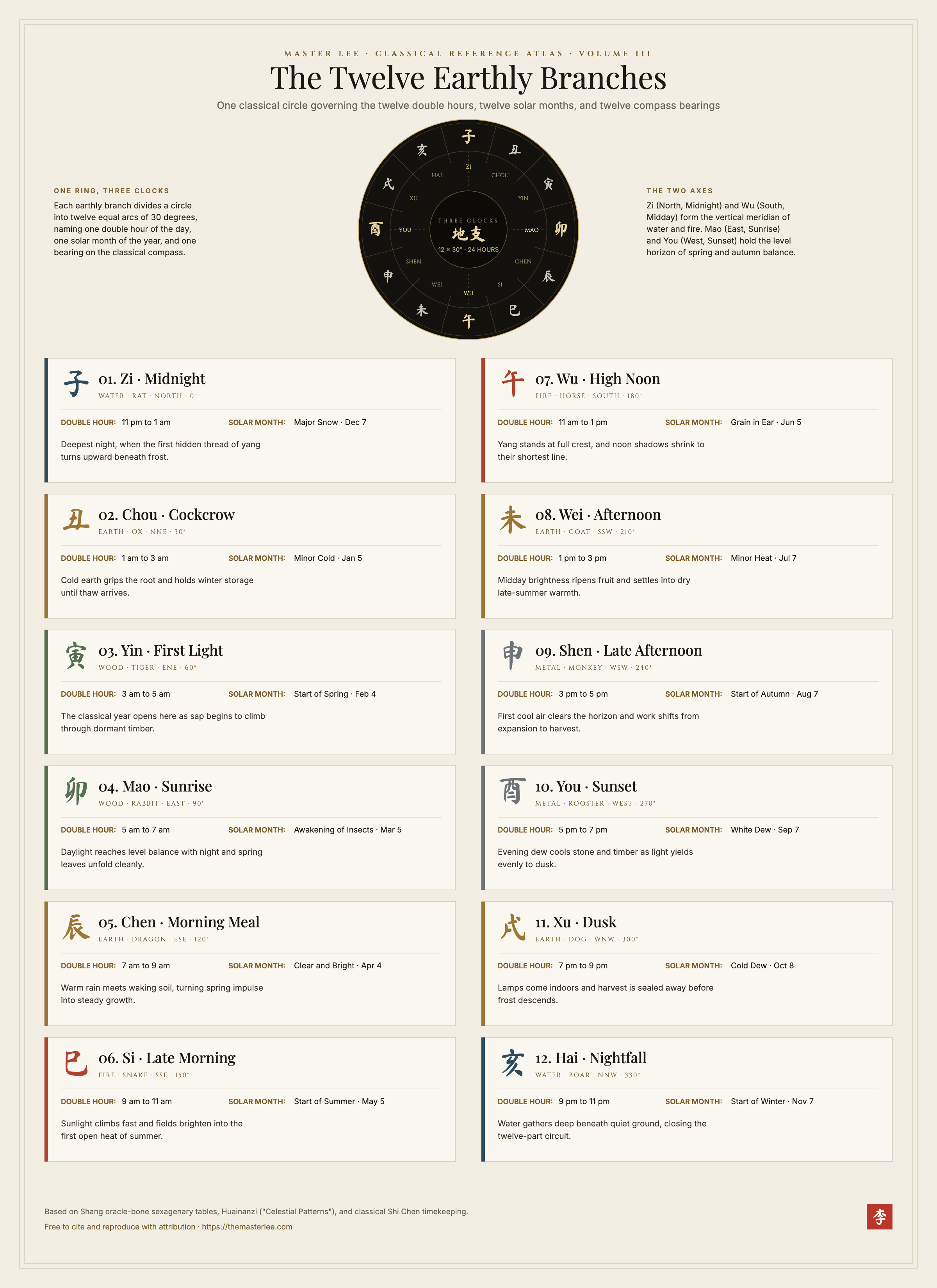
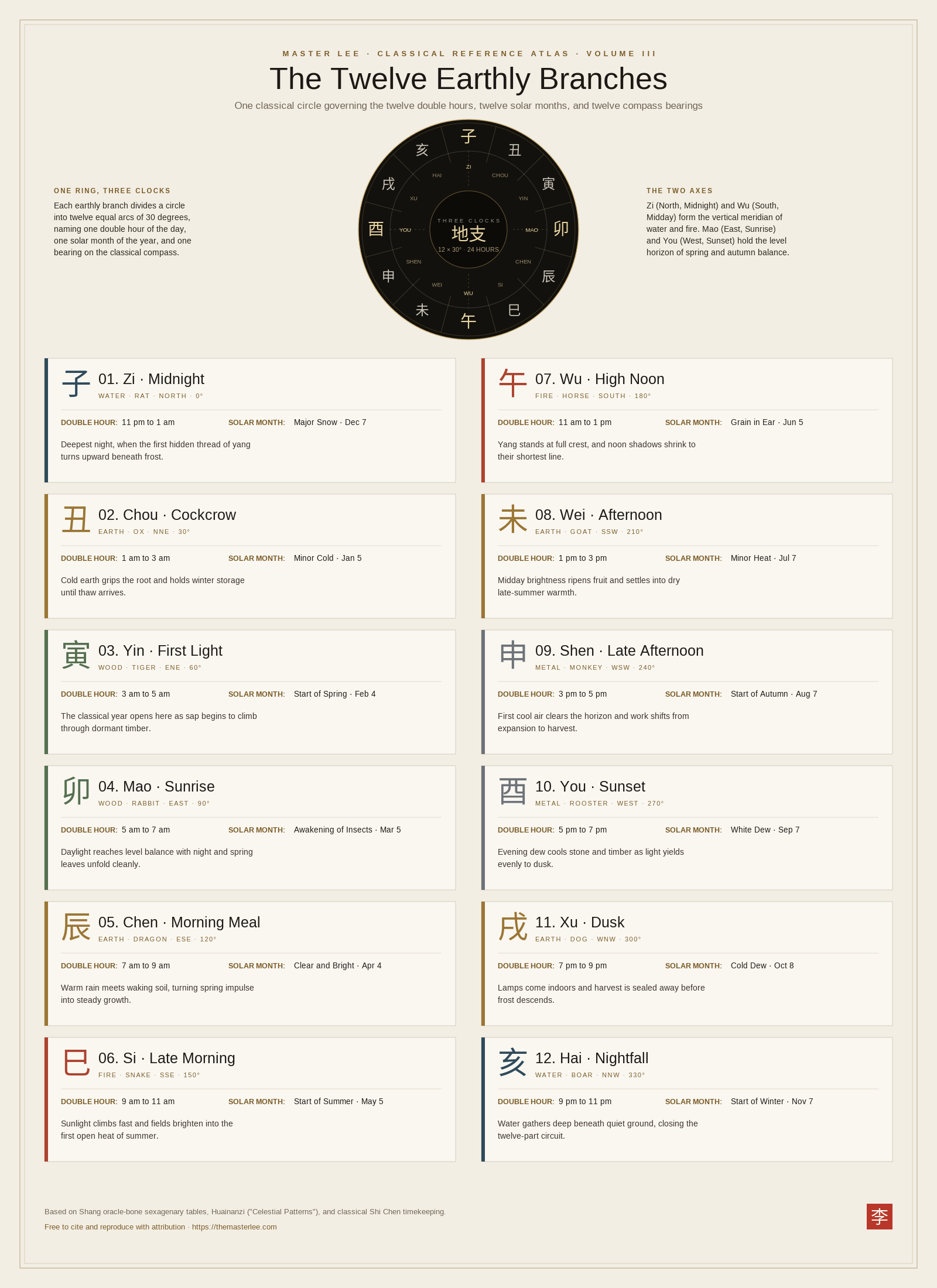
- The Twelve Earthly Branches are a classical Chinese coordinate system dividing a full circle into twelve equal segments named Zi, Chou, Yin, Mao, Chen, Si, Wu, Wei, Shen, You, Xu, and Hai. On one shared dial, those twelve marks simultaneously measure the twelve two-hour watches of a day, the twelve solar-term months of a year, and twelve 30-degree compass sectors around the horizon.
- What are the 12 Chinese double hours?
- Classical Chinese timekeeping divides one twenty-four-hour day into twelve equal periods of two hours each, called double hours in English. Opening with Zi across midnight from 11 pm to 1 am, the daily ring runs clockwise through Chou, Yin, Mao, Chen, Si, Wu from 11 am to 1 pm at Midday, Wei, Shen, You, and Xu, before closing with Hai from 9 pm to 11 pm.
- Why does a Chinese day start at 11 pm?
- Each classical double hour centers on its key astronomical moment across a two-hour span. Because Zi marks true midnight (12:00 am), its two-hour window opens one hour earlier at 11 pm and closes one hour later at 1 am. In classical seasonal and daily observation, Zi holds the northern pivot of the ring where deepest Yin stillness shelters the earliest returning stir of Yang.
- How do the Earthly Branches relate to the Chinese zodiac animals?
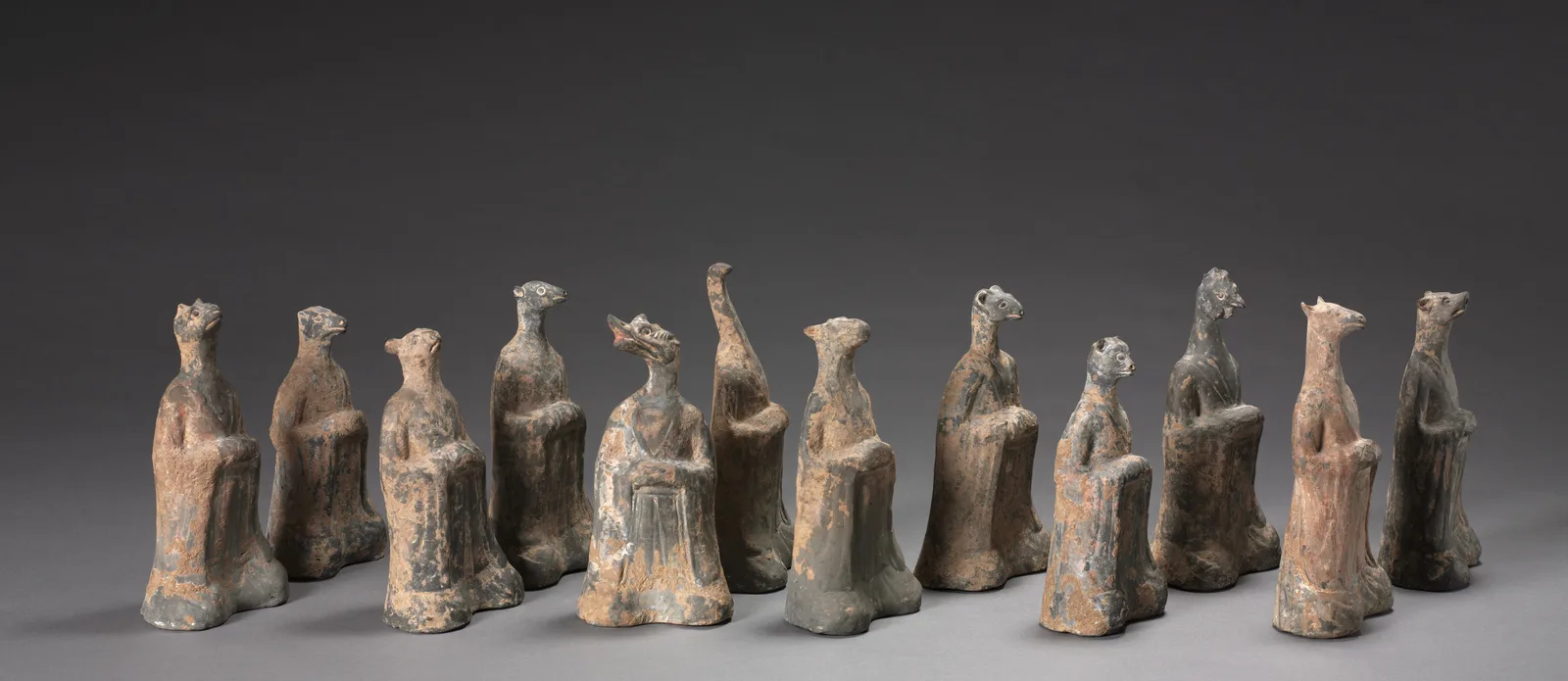
- The twelve branches originated first as an astronomical and calendrical dial, used on Shang dynasty oracle bones to record days more than a millennium before the animal list settled. Early animal pairings appear in Qin bamboo slips buried around 217 BCE, and Eastern Han scholar Wang Chong recorded today's twelve animals, Rat, Ox, Tiger, Rabbit, Dragon, Snake, Horse, Goat, Monkey, Rooster, Dog, and Boar, in the first century CE.
- What is the difference between Heavenly Stems and Earthly Branches?
- The ten Heavenly Stems express Yin and Yang forms of the Five Elements, Wood, Fire, Earth, Metal, and Water, while the Twelve Earthly Branches map the circular ring of hours, solar months, and 30-degree compass bearings. Paired sequentially, Yang stems with Yang branches and Yin stems with Yin branches, they form the sixty-unit cycle counting years, months, days, and hours, including Bing-Wu (2026) and Ding-Wei (2027).
- Which branch rules this month?
- Classical branch months follow the sun's twenty-four solar terms independently of lunar new moons or the first day of a Western month. Yin opens at Start of Spring in early February, Mao at Awakening of Insects in March, Chen at Clear and Bright in April, Si in May, Wu in June, Wei in July, Shen in August, You in September, Xu in October, Hai in November, Zi in December, and Chou in January.
- Do I use clock time or solar time for my birth hour?
- Modern watches show standard zone time shared across wide bands of longitude, along with daylight saving shifts in many regions. Classical timekeeping measures double hours by local true solar time, centering noon Wu on the sun's actual highest crossing over your birthplace. Because watch time and local solar time can differ by tens of minutes, births near an odd-hour mark benefit from longitude calibration.