


Contents What Hong Kong Can Actually Show
That does not prove Qi Men Dun Jia is real. Boardroom behavior is not scientific evidence. It reveals something more limited and more interesting: commercially disciplined people can rely on audits, contracts, models, and conventional advisors while still reserving space for another way of examining timing, position, and human dynamics.
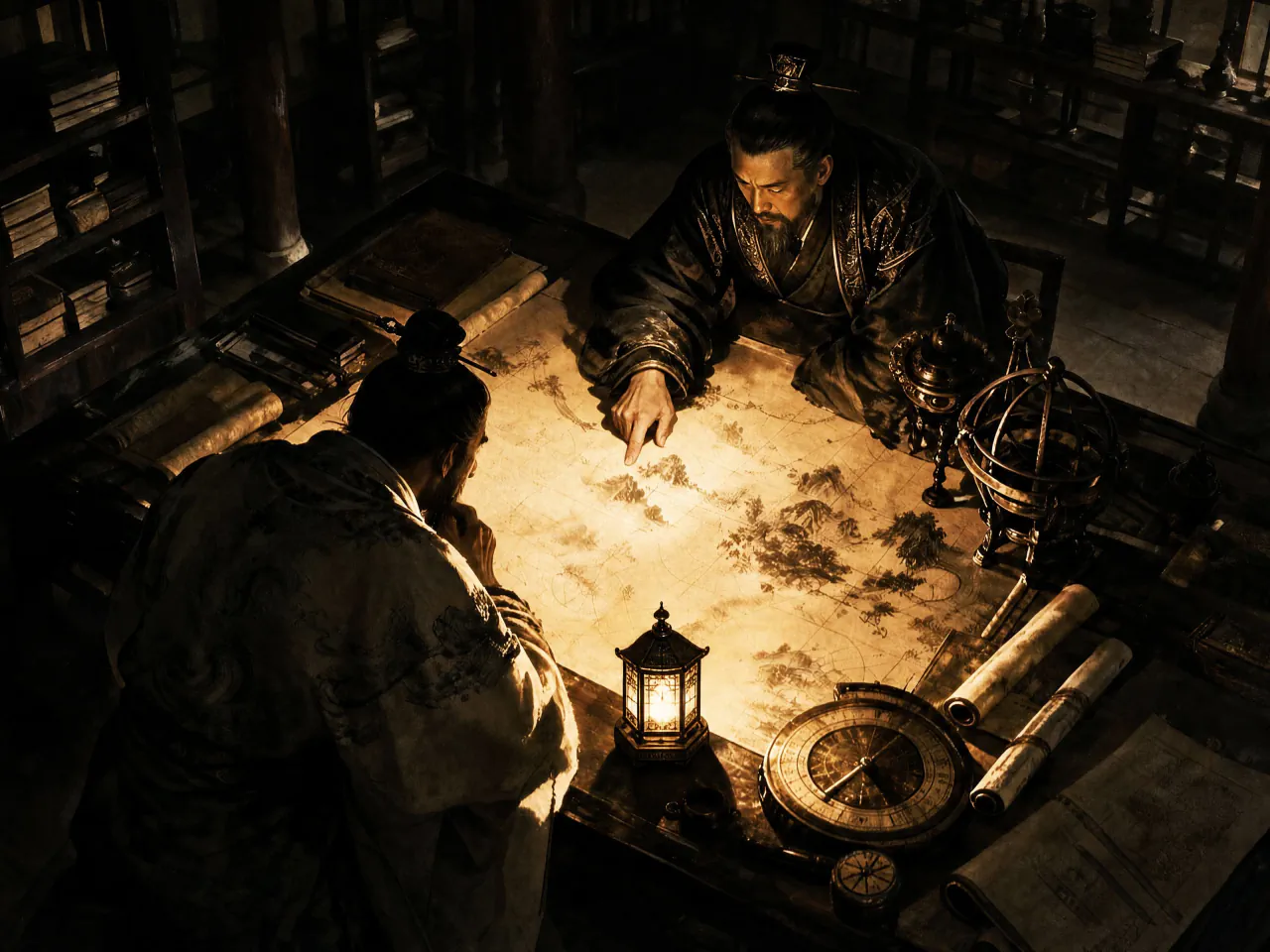
Qi Men Dun Jia (奇门遁甲) is the more private end of that world: a situational planning discipline with Han-era roots, codified across the Tang and Song periods, and restricted for most of its history to imperial courts and military use. The useful question is not whether every Asian executive consults it. They do not. The useful question is why some continue to do so when the stakes rise.
What Hong Kong Can Actually Show
Start with what anyone can verify.
Major banks and property developers in Hong Kong have engaged feng shui consultants during the design of prominent buildings. The practice is discussed openly in the territory's business press, and several of its most recognizable skyscrapers carry decisions shaped by it. Chinese metaphysics is not confined to storefront fortune tellers. It has entered rooms where architecture, capital, and reputation meet.
Date selection follows the same cultural logic. Across Chinese-speaking business communities, auspicious dates are used for openings, ceremonies, launches, and agreements. Nobody involved needs to confuse an almanac with a financial model. They answer different questions.
This public evidence supports a narrow claim: Chinese metaphysical advice has a recognized place in parts of Asian commercial culture. It does not prove the accuracy of Qi Men Dun Jia, and it does not show that every boardroom uses it.
Qi Men Dun Jia occupies a quieter position within this ecosystem. Feng shui was a household art. Qi Men Dun Jia was court knowledge, historically forbidden to civilians, transmitted through closed lineages, and associated with strategists such as Zhuge Liang and Liu Bowen. As it moved from statecraft into commerce, it kept its old character: private, situational, and usually accessed by referral.
That discretion, incidentally, is why Westerners have barely heard of it. Feng shui had storefronts. Qi Men Dun Jia had referrals.
Why Pragmatic People Keep Using It
Longevity is not proof. But dismissing the practice as superstition leaves an important question unanswered. Why would people who already have conventional advice seek another framework at all? Three practical reasons explain the appeal.
1. Asymmetric information
Business is competitive analysis. Both sides may have access to similar market data, advisors, and negotiation frameworks. The executives who consult Qi Men Dun Jia treat the chart as an additional layer of situational analysis: an independent model of the parties, the pressures acting on them, where resistance originates, and which approach the moment favors. Whether an outside observer accepts the model's premises is separate from the user's logic. An unfamiliar framework may force a question the familiar ones missed.
2. Timing discipline
The deeper habit the practice instills is respect for timing as a real variable. The framework underneath Qi Men Dun Jia holds that outcomes are shaped roughly equally by three forces: Heaven for timing and cycles, Earth for position and environment, Human for action and effort. Explore the full method. Western business culture is magnificent on the Human third and strangely careless about the other two. It celebrates speed and force of will; it treats "when" as an afterthought of "what."
Executives shaped by the Chinese classical tradition tend to hold the opposite instinct: the same move, made in a different window, is a different move. A chart that shifts every two hours enforces that instinct as discipline. Sometimes the analysis says press forward. Sometimes it says the configuration is against you, wait for the window. For a decision-maker whose bias is always toward action, a structured reason to wait is not mysticism. It is a governor on the engine, and seasoned operators know the engine needs one.
3. A structured second opinion
At the top of any organization, honest counsel gets scarce. Subordinates filter. Advisors bill. Boards politick. Founders and owners often have no one left who will examine a decision without an interest in the outcome.
A Qi Men Dun Jia consultation functions as a disinterested analysis with a fixed method behind it. The chart does not care what the CEO hopes is true. Its 1,080 configurations produce an assessment from a fixed method and the moment itself, which makes it something rare: a second opinion that cannot be lobbied. Even executives who hold the metaphysics loosely report the same benefit a good devil's advocate provides. The chart forces questions the deal team stopped asking: Who actually holds leverage here? What does the timing favor? Where is the exposure no one has voiced?
What a Consultation Actually Examines
Strip away the unfamiliar vocabulary and a Qi Men Dun Jia business consultation is a structured situation review. A chart is cast for the moment the question is posed, using the traditional double-hour system, and its nine palaces are assigned to the real elements of the case. In practice, the analysis works through four layers:
The parties. You, the counterparty, partners, rivals, decision-makers in the background. The chart models the relative strength and disposition of each: who is genuinely committed, who is stalling, whose position is weaker than it appears.
The timing. Whether the current window favors advancing, renegotiating, or holding, and where the configuration suggests the pressure will ease or intensify.
The positioning. Where advantage sits in the arrangement: which role to occupy, which ground to avoid, whether to lead the conversation or draw the other side into moving first.
The move. The output is never a description of feelings or a general mood. It is directional: a recommended posture and sequence, mapped to the client's actual options.
The client brings the decision. The chart maps the forces around it. The counsel identifies the deliberate move. That grammar, situation to forces to move, is military in origin, and it is exactly why the system aged so well in commerce. Markets are the continuation of terrain by other means.

The Access Problem
For Western decision-makers, the obstacle was never open-mindedness. It was access. The discipline lives in Chinese-language sources and closed family lineages, and its serious practitioners have historically worked by referral only, mostly within Asia.
Master Lee is one of those practitioners, a 22nd-generation heir of a family lineage whose practice was conducted privately for decades, almost entirely for clients who found him the traditional way. His work now makes that private discipline accessible to people outside its traditional circles.
The tools on the 40th floor of a Hong Kong tower have been vetted by people who do not waste money. That is not proof. But it is the kind of signal a good strategist notices.

You Do Not Need a Family Office to Ask
The examples in this article come from the top of the market because that is where the surrounding practices are most visible. It is not where the method is confined.
The method scales with the question, not the status of the person asking it. The same framework that maps a merger can examine a job offer, a relocation, a decision about a business with four employees, or a choice between two paths that will shape the next decade of an ordinary and consequential life. The underlying questions remain structural: who holds leverage, what does the timing favor, and where is the opening?
Frequently Asked Questions
The publicly documented examples are easier to find for feng shui and date selection than for Qi Men Dun Jia. That distinction matters. Qi Men Dun Jia is generally used in private by owners and decision-makers rather than announced in press releases. The claim is not that every major company uses it. The claim is that Chinese commercial culture has long made room for metaphysical counsel, and Qi Men Dun Jia occupies its more private, situational end.
No, though they are related branches of Chinese metaphysics. Feng shui concerns space: the arrangement of environments and how physical surroundings affect the people in them. Qi Men Dun Jia is situational and time-based, mapping a specific question at a specific moment. The historical distinction matters too: feng shui was available to ordinary households, while Qi Men Dun Jia was restricted to the imperial court and forbidden to civilians.
No. Most of the executives who use it across Asia would describe themselves as pragmatists first. It functions as a structured analysis of timing, positioning, and the parties in a situation, and the reasonable posture toward it is the one you would take toward any advisory input: consider the analysis, weigh it against what you know, and judge it by the quality of the decisions it helps you make.
Three reasons recur in practice. It supplies a model of the situation that the counterparty does not have. It enforces attention on timing, which Western business culture systematically underweights. And it provides a second opinion with no stake in the outcome, which becomes genuinely scarce at the top of an organization. None of those benefits require accepting the metaphysics on faith.
No. Executives make useful examples because their decisions make timing, leverage, and competing interests easy to see. The same structure appears in ordinary life whenever a choice has consequences: accepting an offer, entering a partnership, relocating, confronting a stalled negotiation, or deciding whether to move now or wait.
One Decision Is Enough
You do not need a boardroom to have a consequential question. Explore Situation Shift to see how Master Lee applies Qi Men Dun Jia to one specific decision or situation.
Explore Situation ShiftMaster Lee's work is a strategic guidance service. It is not medical, legal, financial, or psychological advice.